

TB-500 Pen
Price range: Rp1,300,000.00 through Rp2,600,000.00 ~$78.79–$157.58
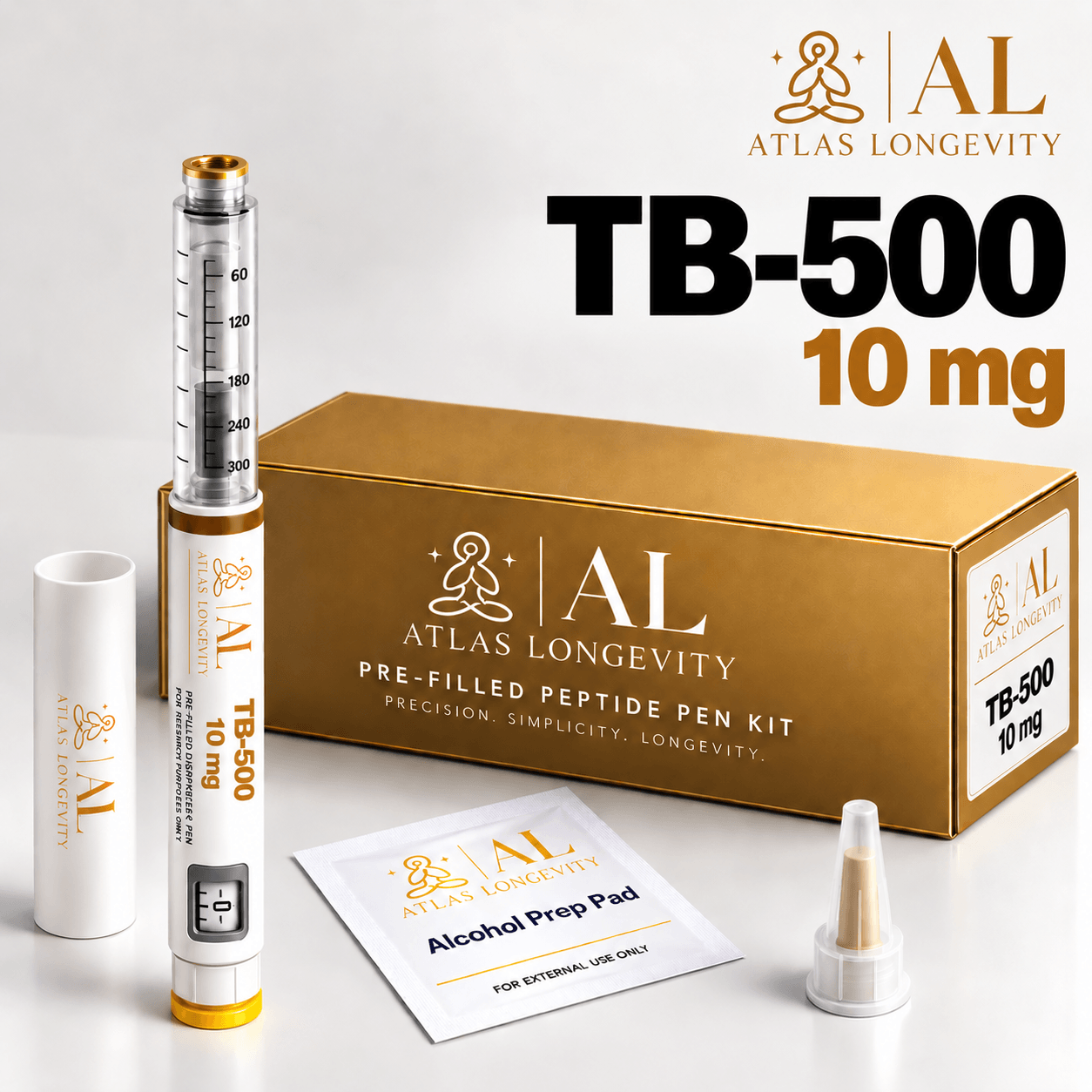
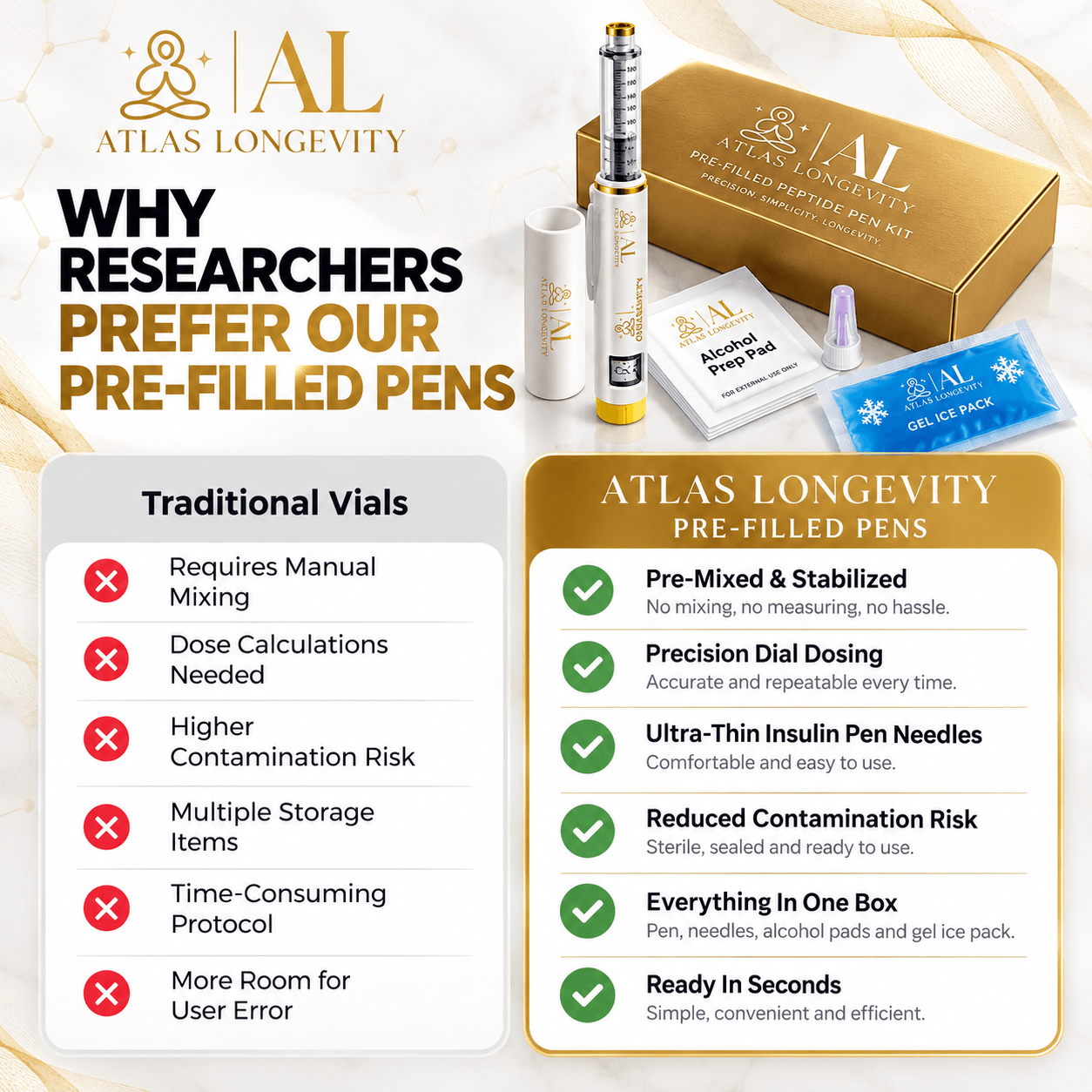
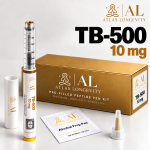
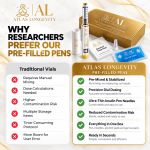
TB-500 10mg Pen is a convenient pre-mixed peptide pen commonly used within recovery, mobility, active lifestyle, and wellness-focused protocols. Ready to use with no mixing required.
💉 Pre-Mixed Pen
⚡ No Mixing Required
🏃 Recovery Support
🚚 Same-Day Bali Delivery
👨⚕️ Expert Guidance Included
TB-500 5 mg / 10 mg Pen
Product Description
TB-500 is a synthetic research peptide described in the supplied material in connection with Thymosin Beta 4 (Tβ4) and studied primarily for its potential role in cellular migration, actin regulation, angiogenesis, connective-tissue remodelling, and regenerative biology.
Research focuses heavily on the interaction between Thymosin Beta 4-related signalling and actin, a structural protein involved in cell movement and cytoskeletal organisation. Preclinical models have also examined VEGF-associated angiogenesis, collagen organisation, inflammatory signalling, and tissue-remodelling processes. Pasted text
Atlas Longevity TB-500 pens use the standard 3 mL / 300-click cartridge system and are available in:
- 5 mg TB-500
- 10 mg TB-500
TB-500 remains an investigational research compound. Most of the evidence presented is derived from animal and in-vitro research, with limited exploratory human evidence, so it should not be presented as an approved treatment for muscle injuries, tendon injuries, wound healing, fibrosis, cardiovascular disease, or other medical conditions. Pasted text
Clinical / Research Status
The supplied material characterizes TB-500 primarily as a preclinical tissue-repair and angiogenesis research compound.
| Evidence Type | Status Based on Supplied Material |
|---|---|
| Human randomized clinical research | Limited / not established |
| Human observational research | Limited |
| Animal research | Yes |
| In-vitro research | Yes |
| Regulatory therapeutic approval | Not established |
The strongest evidence described in the source involves animal injury models, endothelial cultures, connective-tissue research, and other experimental systems. Pasted text
Evidence Type
The supplied material includes research involving:
- full-thickness skin wounds;
- cardiac-injury models;
- Achilles tendon injury;
- corneal repair;
- endothelial-cell cultures;
- central nervous system injury;
- skeletal-muscle injury. Pasted text
These models are useful for studying regenerative mechanisms, but findings from animals or cultured cells should not automatically be treated as established human outcomes.
Mechanism of Action
The main mechanism described for TB-500 involves actin regulation and cytoskeletal remodelling.
Actin is critical for:
- cell shape;
- cellular migration;
- wound closure;
- tissue organisation;
- structural repair.
The source describes TB-500 / Thymosin Beta 4-related activity involving binding to G-actin monomers, which may influence dynamic cytoskeletal organisation and facilitate migration of cells toward areas of experimental tissue stress. Pasted text
Angiogenic Signalling
The source also describes increased VEGF-related signalling in certain preclinical models.
VEGF is involved in:
- endothelial-cell activity;
- new blood-vessel formation;
- vascular remodelling;
- nutrient and oxygen delivery to tissue.
Inflammatory Signalling
Research described in the source also involves changes in NF-κB-related pathways and inflammatory markers.
These mechanisms remain investigational and should not be interpreted as proof of clinically meaningful tissue regeneration in humans.
Potential Benefits / Research Areas
Tissue-Repair Research
TB-500 is extensively discussed in the supplied material in relation to cellular migration and experimental tissue-remodelling processes.
Animal models have reported changes involving:
- muscle-fibre repair;
- connective-tissue organisation;
- angiogenesis;
- collagen alignment. Pasted text
These findings remain primarily preclinical.
Actin Cytoskeleton Research
Actin-related biology is one of the key mechanistic areas associated with TB-500.
Laboratory studies described in the source examine:
- G-actin interactions;
- cytoskeletal reorganisation;
- cell motility;
- wound-closure processes;
- tissue restructuring. Pasted text
Angiogenesis Research
The source describes experimental increases in VEGF-associated signalling and capillary formation in injury models.
This makes TB-500 relevant to research involving:
- angiogenesis;
- vascularisation;
- endothelial migration;
- tissue perfusion. Pasted text
Angiogenesis is a complex biological process, so increased vascular signalling should not automatically be presented as universally beneficial.
Muscle-Recovery Research
Preclinical muscle-injury studies have investigated TB-500 in relation to:
- muscle-fibre regeneration;
- satellite-cell activity;
- tissue architecture;
- fibrosis and scar formation. Pasted text
This does not establish TB-500 as an approved treatment for sports injuries or accelerated human recovery.
Tendon and Connective-Tissue Research
The supplied material describes experimental work involving:
- tendon injury;
- ligament-related repair;
- fibroblast migration;
- collagen organisation;
- structural remodelling. Pasted text
These areas are particularly relevant to musculoskeletal research.
Inflammatory-Signalling Research
TB-500-related experimental models have reported changes in inflammatory mediators including:
- TNF-α;
- IL-6;
- NF-κB-associated signalling. Pasted text
The source presents this as regulatory rather than complete immune suppression.
Fibrosis and Scar-Remodelling Research
Certain preclinical studies described by the source report:
- reduced fibrotic tissue;
- altered collagen organisation;
- lower scar-density measurements. Pasted text
These findings remain experimental and should not be presented as guaranteed anti-scarring effects in humans.
Systemic Distribution Research
The supplied source describes animal research suggesting distribution beyond the immediate administration site. Pasted text
The clinical implications of systemic distribution remain uncertain.
Cardiac and Organ-Tissue Research
Thymosin Beta 4-related signalling has also been investigated in experimental cardiac models.
The source describes research involving:
- endothelial migration;
- cardiac-cell survival;
- ischemic injury;
- tissue repair. Pasted text
These findings are primarily animal and cellular observations and do not establish TB-500 as a cardiovascular treatment.
Research Data
| Study / Model | Reported Finding |
|---|---|
| Rat full-thickness wound model | Increased wound-closure rate, keratinocyte migration and re-epithelialisation |
| Murine cardiac-injury model | Reduced scar formation with increased cardiomyocyte-survival-related measures |
| Rat Achilles tendon injury | Improved collagen organisation and tensile-strength-related measures |
| Rabbit corneal injury models | Accelerated epithelial regeneration with reduced inflammatory infiltration |
| Endothelial-cell culture | Increased angiogenic tube formation and VEGF-associated vascular sprouting |
| Murine CNS injury model | Increased oligodendrocyte differentiation and neurological-recovery measures |
| Rat skeletal-muscle crush injury | Increased satellite-cell activity and reduced fibrotic-tissue deposition |
These findings are predominantly preclinical and do not establish equivalent outcomes in human subjects. Pasted text
Potential Stack / Combination Research
The supplied source discusses experimental combinations involving:
- TB-500 + BPC-157;
- TB-500 + GHK-Cu;
- TB-500 + IGF-1 LR3;
- TB-500 + Epitalon. Pasted text
The theoretical rationale includes combinations of cellular migration, extracellular-matrix biology, growth signalling, angiogenesis, and ageing-related research.
The supplied evidence does not establish validated human safety, efficacy, compatibility, or dosing for these combinations.
They should therefore remain experimental research concepts rather than recommended stacks.
Atlas Longevity TB-500 Pen Dosage / Click Chart
Atlas Longevity TB-500 is available in:
5 mg
and:
10 mg
Both pens use:
3 mL cartridge volume
300 total clicks
1 click = 0.01 mL
Maximum selectable dial amount = 60 clicks
TB-500 5 mg Pen
Pen Specification
| Pen Strength | Volume | Concentration | Amount Per Click |
|---|---|---|---|
| 5 mg | 3 mL | ≈1.667 mg/mL | ≈0.0167 mg / 16.7 mcg |
Concentration Calculation
5 mg ÷ 3 mL = 1.6667 mg/mL
Rounded:
≈1.667 mg/mL
Amount Per Click
5 mg ÷ 300 clicks = 0.016667 mg
Therefore:
1 click ≈0.0167 mg
or:
≈16.7 mcg TB-500
5 mg Pen Click Conversion
| Clicks | Volume | TB-500 Amount |
|---|---|---|
| 1 | 0.01 mL | ≈0.0167 mg / 16.7 mcg |
| 5 | 0.05 mL | ≈0.0833 mg |
| 10 | 0.10 mL | ≈0.1667 mg |
| 15 | 0.15 mL | 0.250 mg |
| 20 | 0.20 mL | ≈0.333 mg |
| 30 | 0.30 mL | 0.500 mg |
| 40 | 0.40 mL | ≈0.667 mg |
| 45 | 0.45 mL | 0.750 mg |
| 50 | 0.50 mL | ≈0.833 mg |
| 60 | 0.60 mL | 1.000 mg |
TB-500 10 mg Pen
Pen Specification
| Pen Strength | Volume | Concentration | Amount Per Click |
|---|---|---|---|
| 10 mg | 3 mL | ≈3.333 mg/mL | ≈0.0333 mg / 33.3 mcg |
Concentration Calculation
10 mg ÷ 3 mL = 3.3333 mg/mL
Rounded:
≈3.333 mg/mL
Amount Per Click
10 mg ÷ 300 clicks = 0.033333 mg
Therefore:
1 click ≈0.0333 mg
or:
≈33.3 mcg TB-500
10 mg Pen Click Conversion
| Clicks | Volume | TB-500 Amount |
|---|---|---|
| 1 | 0.01 mL | ≈0.0333 mg / 33.3 mcg |
| 5 | 0.05 mL | ≈0.1667 mg |
| 10 | 0.10 mL | ≈0.333 mg |
| 15 | 0.15 mL | 0.500 mg |
| 20 | 0.20 mL | ≈0.667 mg |
| 30 | 0.30 mL | 1.000 mg |
| 40 | 0.40 mL | ≈1.333 mg |
| 45 | 0.45 mL | 1.500 mg |
| 50 | 0.50 mL | ≈1.667 mg |
| 60 | 0.60 mL | 2.000 mg |
Useful Conversions
5 mg pen:
- 15 clicks = 0.25 mg
- 30 clicks = 0.50 mg
- 45 clicks = 0.75 mg
- 60 clicks = 1 mg
10 mg pen:
- 15 clicks = 0.50 mg
- 30 clicks = 1 mg
- 45 clicks = 1.50 mg
- 60 clicks = 2 mg
These are concentration calculations and not dosing recommendations.
Protocol / Dosage Information
The supplied reference describes experimental quantities ranging from approximately 2 mg to 10 mg. Pasted text
Its original calculations were based on different 2 mL formulations, so those click values must not be applied to the Atlas Longevity pens.
Using the Atlas 3 mL / 300-click system:
| Source-Referenced Amount | 5 mg Pen | 10 mg Pen |
|---|---|---|
| 2 mg | 120 total clicks | 60 clicks |
| 2.5 mg | 150 total clicks | 75 total clicks |
| 5 mg | 300 total clicks | 150 total clicks |
| 10 mg | 600 total clicks* | 300 total clicks |
*The 5 mg Atlas pen contains only 5 mg total, so 10 mg exceeds the entire contents of one 5 mg pen.
Important Pen Limitation
The Atlas pen allows a maximum single dial selection of:
60 clicks
Therefore:
5 mg Pen
- Maximum single selectable amount = 1 mg
- 2 mg = 120 clicks mathematically
- 2.5 mg = 150 clicks mathematically
- 5 mg = 300 clicks mathematically
10 mg Pen
- Maximum single selectable amount = 2 mg
- 2.5 mg = 75 clicks mathematically
- 5 mg = 150 clicks mathematically
- 10 mg = 300 clicks mathematically
Amounts exceeding 60 clicks cannot be selected as one dial amount.
These larger equivalents are included only to translate quantities appearing in the supplied research material. They are not instructions to split, repeat, or administer multiple injections.
The source’s frequency, duration, loading, tapering, and cycling schedules should not be carried into Atlas content as human dosing instructions.
Possible Side Effects
The supplied material describes TB-500 as generally tolerated in animal research and limited observational reports, but human safety evidence remains insufficient.
Reported or proposed observations include:
- localized redness;
- injection-site tenderness;
- irritation;
- temporary fatigue or lethargy;
- headache;
- light-headedness;
- temporary flu-like sensations;
- gastrointestinal sensitivity;
- mild nausea. Pasted text
Angiogenesis and Cell-Migration Considerations
TB-500 is specifically studied for pathways involving angiogenesis and cellular migration.
Because these pathways can have complex biological effects, their activation should not automatically be characterized as universally beneficial.
Long-term systemic safety remains under investigation.
Important uncertainties include:
- prolonged exposure;
- abnormal angiogenic signalling;
- unwanted cell-migration effects;
- interactions with medications;
- effects in individuals with active malignancy or abnormal tissue growth;
- pregnancy and reproductive exposure;
- long-term cardiovascular effects;
- combination protocols.
The source’s statement that significant systemic effects were not observed in available preclinical data should not be interpreted as proof of human safety.
Product Attributes
| Attribute | Information |
|---|---|
| Product Name | TB-500 |
| Related Name in Supplied Source | Thymosin Beta 4 / Tβ4 |
| CAS Number listed by source | 77591-33-4 |
| Molecular Formula | C212H350N56O78S |
| Amino Acid Sequence | SDKPDMAEIEKFDKSKLKKTETQEKNPLPSKETIEQEKQAGES |
| Molecular Weight | 4963.4 g/mol |
| PubChem CID | 16132341 |
| Half-Life listed by source | Approximately 2–3 hours |
| Synonyms listed by source | Thymosin Beta 4, TB4, TMSB4X, Tβ4 |
| Compound Type | Actin-associated synthetic research peptide |
| Research Focus | Tissue regeneration, angiogenesis, connective tissue and recovery |
These technical specifications are reported in the supplied source. Pasted text
Compound Identity Note
The source identifies the product as “TB-500 (Thymosin Beta 4)” and provides the full amino-acid sequence and molecular specifications shown above.
Because the exact identity, sequence, and salt/form used in the finished Atlas product should match its actual analytical documentation, Atlas should verify these specifications against the product COA before publishing them as final product data.
What’s Included
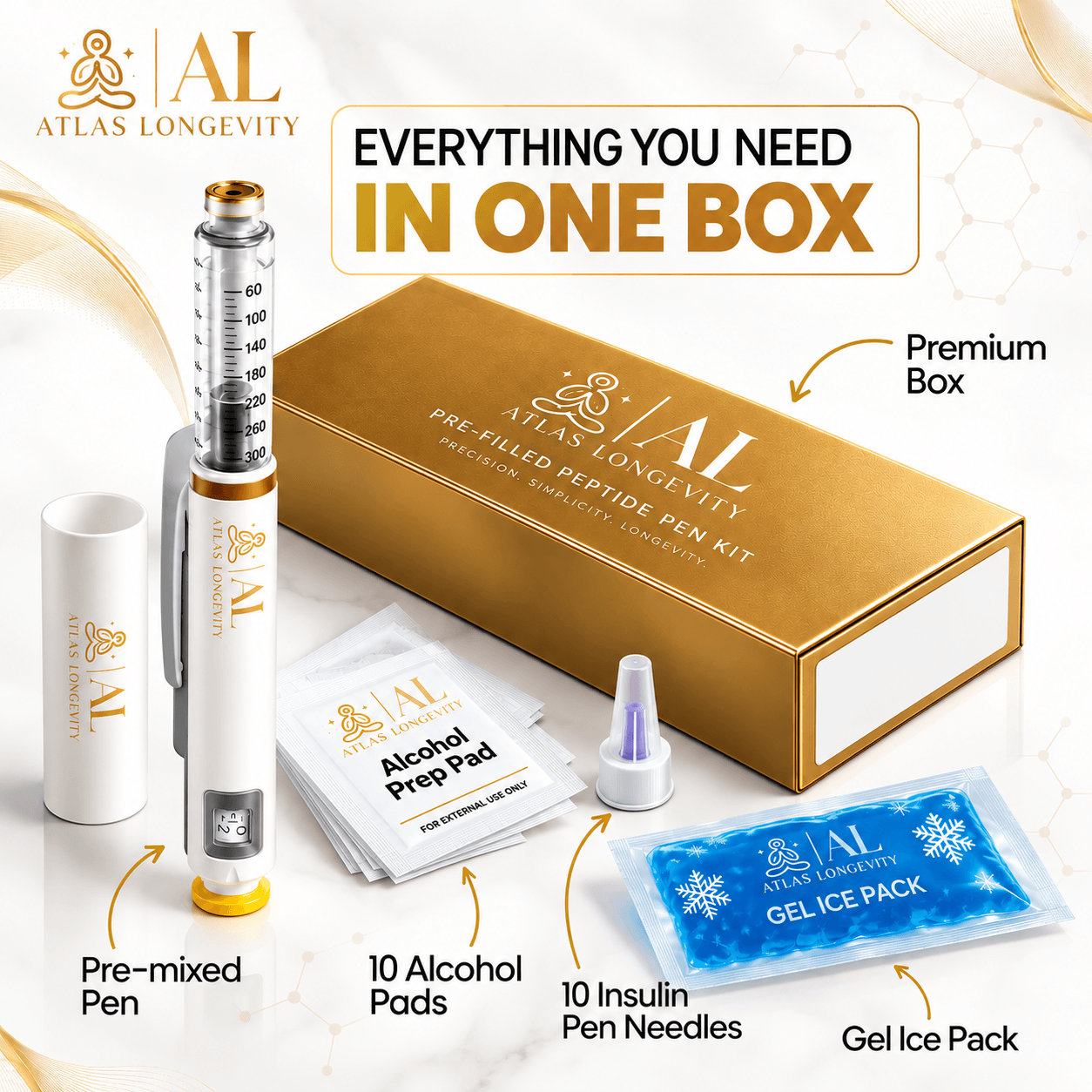
Atlas Longevity TB-500 Pen
- 1 × Atlas Longevity TB-500 pen
- Selected strength: 5 mg or 10 mg
- 3 mL cartridge volume
- 300 total pen units / clicks
- 0.01 mL per click
- 5 mg pen: approximately 16.7 mcg TB-500 per click
- 10 mg pen: approximately 33.3 mcg TB-500 per click
- 1–60 unit selectable dial range
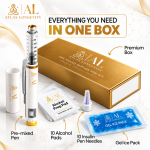
No additional needles, alcohol pads, storage case, packaging accessories, or other contents are listed because Atlas Longevity-specific accessory information was not supplied.
Storage
Storage conditions should follow the instructions supplied specifically with the Atlas Longevity TB-500 formulation.
The reference product provides refrigeration and stability specifications for its own finished formulation. Those conditions should not automatically be transferred to Atlas Longevity without product-specific stability evidence.
Follow the temperature requirements, light-protection guidance, handling instructions, and shelf-life information shown on the Atlas Longevity product label or accompanying documentation.
Frequently Asked Questions
What is TB-500?
TB-500 is an investigational peptide described in the supplied source in connection with Thymosin Beta 4 and studied primarily for actin regulation, cellular migration, angiogenesis, and tissue-remodelling biology. Pasted text
How does TB-500 work?
The supplied research focuses primarily on interaction with actin-related cellular processes.
These processes influence cytoskeletal organisation and cellular movement, which are important during experimental tissue remodelling and repair. Pasted text
What is actin?
Actin is a major structural protein within cells.
It contributes to:
- cell shape;
- movement;
- cytoskeletal organisation;
- migration;
- tissue-remodelling processes.
Actin-related signalling is one of the main mechanisms investigated in TB-500 research.
What is TB-500 researched for?
Research areas include:
- tissue remodelling;
- cellular migration;
- angiogenesis;
- muscle injury;
- tendon biology;
- collagen organisation;
- fibrosis;
- wound models;
- endothelial signalling;
- cardiac tissue research.
Most evidence remains preclinical.
Has TB-500 been studied in humans?
The supplied source describes limited human exploratory or observational evidence, while the majority of the research presented is animal or in-vitro. Pasted text
Is TB-500 approved for healing injuries?
The supplied material does not establish regulatory approval of TB-500 as a treatment for muscle, tendon, ligament, or other injuries.
Its use should remain framed as experimental research.
Does TB-500 increase angiogenesis?
Preclinical studies described in the source report changes involving VEGF expression, endothelial migration, and new-vessel formation. Pasted text
These findings do not prove a predictable human therapeutic effect.
Does TB-500 reduce scar tissue?
Certain animal studies described by the source report reduced fibrotic tissue and changes in collagen organisation. Pasted text
This does not establish TB-500 as a clinically proven anti-scarring treatment.
What strengths are available?
Atlas Longevity TB-500 pens are available in:
5 mg
and:
10 mg
How much TB-500 is in one click of the 5 mg pen?
The 5 mg pen contains:
5 mg ÷ 300 = approximately 0.0167 mg
Therefore:
1 click ≈16.7 mcg TB-500
How much TB-500 is in one click of the 10 mg pen?
The 10 mg pen contains:
10 mg ÷ 300 = approximately 0.0333 mg
Therefore:
1 click ≈33.3 mcg TB-500
How many clicks equal 0.5 mg?
For the 5 mg pen:
30 clicks = 0.50 mg
For the 10 mg pen:
15 clicks = 0.50 mg
How many clicks equal 1 mg?
For the 5 mg pen:
60 clicks = 1 mg
For the 10 mg pen:
30 clicks = 1 mg
How many clicks equal 2 mg?
For the 5 mg pen:
120 clicks mathematically, which exceeds the 60-click single-dial range.
For the 10 mg pen:
60 clicks = 2 mg
These are concentration calculations rather than dosing recommendations.
Can 2.5 mg be selected in one dial operation?
No.
Mathematically:
5 mg pen: 2.5 mg = 150 clicks
10 mg pen: 2.5 mg = 75 clicks
Both exceed the Atlas pen’s 60-click maximum single dial selection.
This is a mechanical calculation only and does not provide instructions for administering that quantity.
What is the maximum selectable amount?
The maximum single dial selection is:
60 clicks
For the 5 mg pen:
60 clicks = 1 mg
For the 10 mg pen:
60 clicks = 2 mg
The mechanical limit is not a recommended research quantity.
How long does a 5 mg TB-500 pen last?
The full pen contains:
300 clicks and 5 mg TB-500.
For cartridge-capacity calculations only:
- 15 clicks at a time = 20 administrations
- 30 clicks at a time = 10 administrations
- 60 clicks at a time = 5 administrations
These examples describe capacity rather than a treatment schedule.
How long does a 10 mg TB-500 pen last?
The full pen contains:
300 clicks and 10 mg TB-500.
For cartridge-capacity calculations only:
- 15 clicks at a time = 20 administrations
- 30 clicks at a time = 10 administrations
- 60 clicks at a time = 5 administrations
Does the product disappear when the dial returns to zero?
No.
The dial returns to zero after administration while the unused formulation remains inside the cartridge.
The remaining TB-500 stays in the pen until all 300 units have been used.
Can TB-500 be combined with BPC-157?
The supplied source discusses TB-500 + BPC-157 as an experimental research concept involving complementary tissue-remodelling pathways. Pasted text
Validated human safety, efficacy, compatibility, and dosing for the combination are not established by the supplied material.
Is TB-500 the same as Thymosin Beta 4?
The supplied source treats TB-500 and Thymosin Beta 4 as equivalent terminology and provides Thymosin Beta 4-related molecular specifications. Pasted text
For the Atlas product page, the exact compound identity should be confirmed against the actual COA before final technical specifications are published.
What is the half-life of TB-500?
The supplied source lists an approximate half-life of 2–3 hours and also describes systemic distribution lasting longer. Pasted text
This source-reported value should not automatically be treated as formulation-specific pharmacokinetic data for the Atlas pen.
Is there an established human TB-500 dosage?
The supplied source contains experimental quantities but does not establish a universally accepted, approved human therapeutic dose.
The Atlas click charts therefore represent concentration mathematics only.
How should the Atlas Longevity TB-500 pen be stored?
Follow the storage instructions supplied specifically with the actual Atlas Longevity formulation.
The reference manufacturer’s refrigeration and stability claims apply to its own finished product and should not automatically be transferred to Atlas without product-specific stability evidence.
Related products
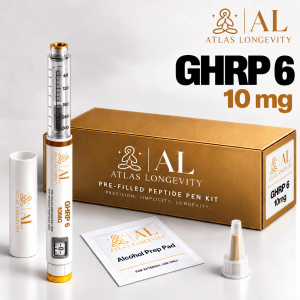
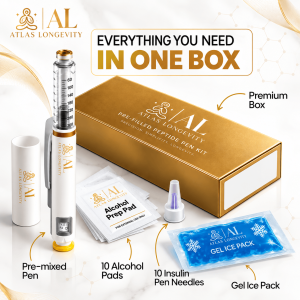
GHRP 6 10MG
Price range: Rp1,900,000.00 through Rp2,500,000.00 ~$115.15–$151.52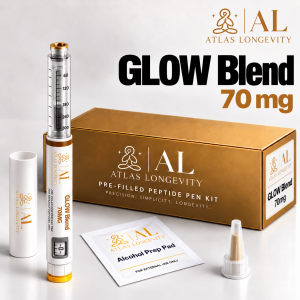
Glow Plus 70mg Pen (GHK-Cu + BPC-157 + TB-500)
Price range: Rp3,000,000.00 through Rp3,600,000.00 ~$181.82–$218.18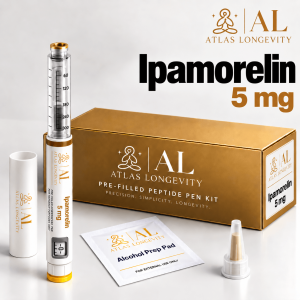
Ipamorelin Pen
Price range: Rp1,200,000.00 through Rp2,300,000.00 ~$72.73–$139.39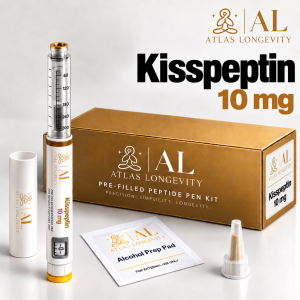
Kisspeptin 10mg Pen
Price range: Rp1,700,000.00 through Rp2,300,000.00 ~$103.03–$139.39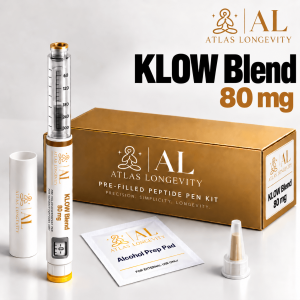
KLOW 80mg Pen (GHK-Cu + KPV + BPC-157 + TB-500)
Price range: Rp3,200,000.00 through Rp3,800,000.00 ~$193.94–$230.30
 Peptide Vials
 Peptide Nasal Sprays
 Peptide Protocols
 Bundles