

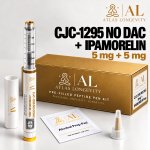
CJC-1295 No DAC 5mg + Ipamorelin 5mg Pen
Price range: Rp1,900,000.00 through Rp2,500,000.00 ~$115.15–$151.52
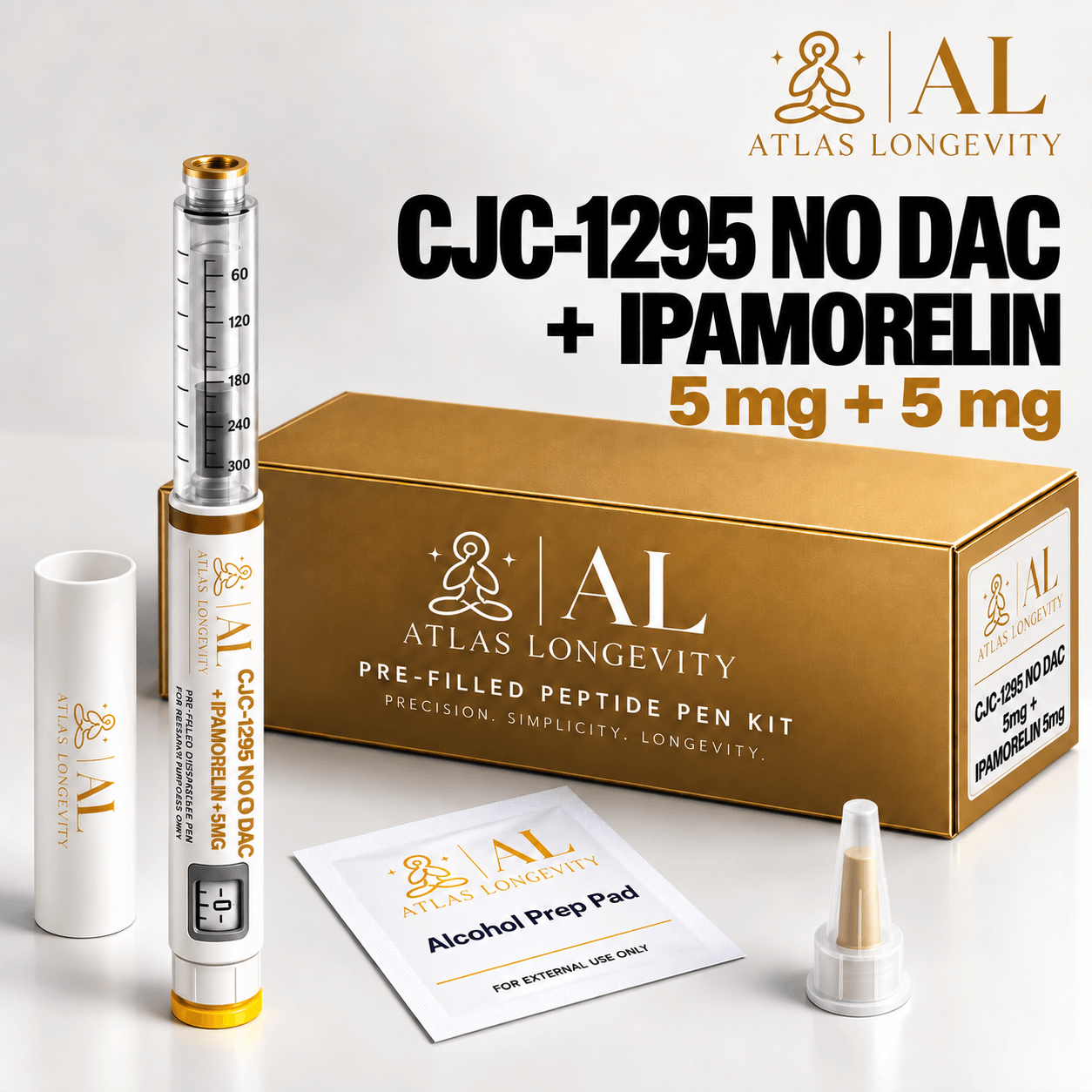
CJC-1295 No DAC 5mg + Ipamorelin 5mg Pen combines two of the most popular recovery and performance-focused peptides into one convenient pre-mixed peptide pen designed for simplicity and convenience.
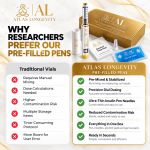
💉 Pre-Mixed Pen
⚡ No Mixing Required
💪 Recovery Support
🏋️ Gym User Favourite
🚚 Same-Day Bali Delivery
👨⚕️ Expert Guidance Included
CJC-1295 (No-DAC) + Ipamorelin Pen
Product Description
CJC-1295 (No-DAC) + Ipamorelin is a research peptide combination designed to investigate two complementary pathways involved in pulsatile growth hormone signalling.
CJC-1295 (No-DAC) acts as a synthetic analogue of growth hormone-releasing hormone (GHRH), while Ipamorelin acts primarily through the growth hormone secretagogue receptor (GHS-R1a), commonly associated with ghrelin signalling.
By targeting different receptors involved in growth hormone release, the combination is studied for its potential to influence the amplitude and pattern of endogenous GH secretion rather than supplying exogenous growth hormone directly. Pasted text
Research interest includes the GH/IGF-1 axis, recovery biology, body-composition signalling, collagen synthesis, connective-tissue biology, and metabolic regulation.
Atlas Longevity CJC-1295 (No-DAC) + Ipamorelin pens use the standard 3 mL cartridge / 300-click system and are available in two strengths:
- 5 mg CJC-1295 (No-DAC) + 5 mg Ipamorelin
- 5 mg CJC-1295 (No-DAC) + 10 mg Ipamorelin
These compounds remain investigational and are not established as approved therapeutic treatments.
Clinical / Research Status
The supplied reference describes both CJC-1295-related and Ipamorelin research spanning human, animal, observational, and laboratory evidence.
However, the strength of evidence is not equal across all proposed uses, and the supplied information does not establish regulatory approval for this combination as a therapeutic treatment. Pasted text
| Evidence Type | Status Based on Supplied Material |
|---|---|
| Human clinical research | Yes |
| Observational research | Yes |
| Animal research | Yes |
| In-vitro research | Yes |
| Approved therapeutic use | Not established |
The reference also lists a regulatory document concerning the combination, but the existence of regulatory documentation should not be confused with therapeutic approval. Pasted text
Evidence Type
The supplied material discusses:
- human research involving growth-hormone-releasing hormone analogues;
- human safety research;
- growth hormone and IGF-1 measurements;
- animal metabolic models;
- pituitary-cell research;
- somatotroph laboratory models;
- comparative growth hormone secretagogue studies;
- pharmacodynamic and mechanistic research.
Some cited research concerns the individual components or related CJC-1295 formulations rather than necessarily the exact Atlas CJC-1295 (No-DAC) + Ipamorelin combination.
For this reason, findings should be interpreted according to the compound, formulation, and study model actually investigated.
Mechanism of Action
CJC-1295 (No-DAC)
CJC-1295 (No-DAC) is designed to interact with GHRH receptors on pituitary somatotroph cells.
Activation of these receptors can stimulate growth hormone synthesis and release while remaining connected to endogenous hypothalamic-pituitary signalling.
The No-DAC formulation is intended for research into shorter-duration, pulsatile signalling rather than prolonged exposure.
Ipamorelin
Ipamorelin is a selective growth hormone secretagogue that acts primarily through the GHS-R1a receptor.
Activation of this receptor can stimulate intracellular signalling that promotes growth hormone release.
The supplied material describes Ipamorelin as being studied for relatively selective GH stimulation compared with secretagogues that can have broader endocrine effects. Pasted text
Dual-Pathway Research
When the two compounds are investigated together, the scientific rationale is that they stimulate growth hormone release through different but complementary receptor systems.
Researchers therefore examine whether simultaneous GHRH-receptor and GHS-R1a signalling can influence GH pulse amplitude, downstream IGF-1 signalling, metabolism, and regenerative pathways.
This mechanism does not establish guaranteed clinical effects in humans.
Potential Benefits / Research Areas
Growth Hormone Pulsatility Research
One of the principal areas of interest is the combination’s influence on endogenous growth hormone secretion.
Rather than acting as growth hormone itself, the compounds are studied as signalling molecules that may influence the body’s own GH-release pathways.
The supplied source describes increased GH signalling and downstream IGF-1 activity as central areas of investigation. Pasted text
Muscle Recovery Research
The GH/IGF-1 system participates in protein metabolism, tissue repair, and skeletal-muscle biology.
Experimental research involving growth hormone secretagogues has therefore examined markers related to:
- muscle-fibre repair;
- protein synthesis;
- nitrogen metabolism;
- satellite-cell activity;
- recovery following physical stress.
The supplied source discusses these mechanisms, but they should not be interpreted as proof of predictable muscle gain in humans. Pasted text
Metabolic and Adipose-Tissue Research
Growth hormone signalling can influence lipid mobilisation and energy metabolism.
For this reason, CJC-1295 (No-DAC) + Ipamorelin research includes investigation of:
- lipolysis;
- fatty-acid mobilisation;
- adipose-tissue metabolism;
- body-composition signalling;
- metabolic fuel utilisation. Pasted text
These mechanisms do not establish the combination as an approved weight-loss treatment.
Collagen and Connective-Tissue Research
The GH/IGF-1 pathway is involved in collagen metabolism and connective-tissue biology.
Research interest therefore includes potential effects on:
- collagen production;
- tendon and ligament biology;
- skin extracellular matrix;
- connective-tissue recovery;
- musculoskeletal regeneration.
The supplied reference discusses collagen and tissue-repair effects, although clinical outcomes for specific injuries are not established. Pasted text
Bone Metabolism Research
Growth hormone and IGF-1 signalling interact with bone remodelling and osteoblast activity.
The combination is therefore of experimental interest in studies examining bone metabolism, mineralisation, and age-related changes in musculoskeletal biology.
This research area should not be interpreted as evidence that the combination treats osteoporosis or other bone disorders.
Sleep and Circadian GH Research
Growth hormone secretion naturally follows a pulsatile pattern, with substantial secretion associated with sleep.
The supplied source discusses the combination in relation to nocturnal GH secretion and sleep-associated recovery processes. Pasted text
However, the evidence supplied is not sufficient to present improved sleep quality as a guaranteed clinical benefit.
Regenerative and Recovery Research
Growth hormone and IGF-1 participate in multiple pathways related to cellular repair.
Researchers therefore investigate GH secretagogues in models involving:
- muscle recovery;
- collagen synthesis;
- tissue remodelling;
- physical stress;
- connective-tissue repair.
Human therapeutic recovery claims cannot be established from these mechanisms alone.
Endocrine Rhythm Research
The No-DAC formulation is of particular interest in research focused on pulsatile rather than continuously elevated GH signalling.
This makes the combination relevant to studies examining the timing, amplitude, and physiological pattern of pituitary growth hormone release.
Research Data
| Study / Model | Reported Finding |
|---|---|
| Rat pituitary-cell assays | Increased GH release following GHRH-receptor stimulation |
| Human GH-related research described by source | Increased GH and IGF-1 measurements were reported |
| Preclinical metabolic models | Changes in fat mass, lean tissue and GH-mediated metabolic signalling |
| Aged rodent models | Changes in collagen synthesis and muscle-fibre repair |
| Comparative GHRP research | Ipamorelin showed relatively limited cortisol response compared with some other GHRPs |
| In-vitro somatotroph models | Dual-receptor signalling increased GH-related secretory responses |
The source includes both human and preclinical research, but findings from animal or cellular studies should not be presented as established human outcomes. Pasted text
Potential Stack / Combination Research
The supplied reference discusses experimental research concepts combining CJC-1295 (No-DAC) + Ipamorelin with:
- GHK-Cu;
- BPC-157 and TB-500;
- NAD+;
- MOTS-c. Pasted text
The theoretical rationale involves complementary pathways related to tissue repair, mitochondrial metabolism, cellular energy, and recovery biology.
However, the supplied material does not establish validated human safety, compatibility, efficacy, or optimal dosing for these combinations.
They should therefore be treated as experimental research concepts rather than recommended stacks.
Atlas Longevity CJC-1295 (No-DAC) + Ipamorelin Pen Dosage / Click Chart
Atlas Longevity pens contain:
3 mL total volume
300 total clicks
1 click = 0.01 mL
Maximum selectable dial amount = 60 clicks
Two concentration variants are described below.
5 mg CJC-1295 (No-DAC) + 5 mg Ipamorelin Pen
This pen contains:
- 5 mg CJC-1295 (No-DAC)
- 5 mg Ipamorelin
- 10 mg combined peptide content
| Pen Strength | Volume | Total Concentration | Total Amount Per Click |
|---|---|---|---|
| 5 mg + 5 mg | 3 mL | ≈3.333 mg/mL | ≈0.0333 mg |
Individual Compound Concentrations
CJC-1295 (No-DAC):
5 mg ÷ 3 mL = ≈1.667 mg/mL
5 mg ÷ 300 = ≈0.0167 mg / 16.7 mcg per click
Ipamorelin:
5 mg ÷ 3 mL = ≈1.667 mg/mL
5 mg ÷ 300 = ≈0.0167 mg / 16.7 mcg per click
Therefore:
1 click ≈ 16.7 mcg CJC-1295 + 16.7 mcg Ipamorelin
Total ≈33.3 mcg per click
5 mg + 5 mg Click Conversion
| Clicks | Volume | CJC-1295 | Ipamorelin | Total Peptide |
|---|---|---|---|---|
| 1 | 0.01 mL | ≈0.0167 mg | ≈0.0167 mg | ≈0.0333 mg |
| 5 | 0.05 mL | ≈0.0833 mg | ≈0.0833 mg | ≈0.1667 mg |
| 10 | 0.10 mL | ≈0.1667 mg | ≈0.1667 mg | ≈0.3333 mg |
| 15 | 0.15 mL | 0.250 mg | 0.250 mg | 0.500 mg |
| 20 | 0.20 mL | ≈0.3333 mg | ≈0.3333 mg | ≈0.6667 mg |
| 30 | 0.30 mL | 0.500 mg | 0.500 mg | 1.000 mg |
| 40 | 0.40 mL | ≈0.6667 mg | ≈0.6667 mg | ≈1.333 mg |
| 45 | 0.45 mL | 0.750 mg | 0.750 mg | 1.500 mg |
| 50 | 0.50 mL | ≈0.8333 mg | ≈0.8333 mg | ≈1.667 mg |
| 60 | 0.60 mL | 1.000 mg | 1.000 mg | 2.000 mg |
5 mg CJC-1295 (No-DAC) + 10 mg Ipamorelin Pen
This variant contains:
- 5 mg CJC-1295 (No-DAC)
- 10 mg Ipamorelin
- 15 mg combined peptide content
| Pen Strength | Volume | Total Concentration | Total Amount Per Click |
|---|---|---|---|
| 5 mg + 10 mg | 3 mL | 5 mg/mL | 0.05 mg |
Individual Compound Concentrations
CJC-1295 (No-DAC):
5 mg ÷ 3 mL = ≈1.667 mg/mL
5 mg ÷ 300 = ≈0.0167 mg / 16.7 mcg per click
Ipamorelin:
10 mg ÷ 3 mL = ≈3.333 mg/mL
10 mg ÷ 300 = ≈0.0333 mg / 33.3 mcg per click
Therefore:
1 click ≈16.7 mcg CJC-1295 + 33.3 mcg Ipamorelin
Total = 50 mcg per click
5 mg + 10 mg Click Conversion
| Clicks | Volume | CJC-1295 | Ipamorelin | Total Peptide |
|---|---|---|---|---|
| 1 | 0.01 mL | ≈0.0167 mg | ≈0.0333 mg | 0.050 mg |
| 5 | 0.05 mL | ≈0.0833 mg | ≈0.1667 mg | 0.250 mg |
| 10 | 0.10 mL | ≈0.1667 mg | ≈0.3333 mg | 0.500 mg |
| 15 | 0.15 mL | 0.250 mg | 0.500 mg | 0.750 mg |
| 20 | 0.20 mL | ≈0.3333 mg | ≈0.6667 mg | 1.000 mg |
| 30 | 0.30 mL | 0.500 mg | 1.000 mg | 1.500 mg |
| 40 | 0.40 mL | ≈0.6667 mg | ≈1.333 mg | 2.000 mg |
| 50 | 0.50 mL | ≈0.8333 mg | ≈1.667 mg | 2.500 mg |
| 60 | 0.60 mL | 1.000 mg | 2.000 mg | 3.000 mg |
The 60-click maximum is a mechanical pen limit, not a recommended amount.
Protocol / Dosage Information
The original source describes experimental total quantities of approximately 0.75 mg, 1 mg, and 1.5 mg in its proposed research protocols. Pasted text
Those source calculations were based on a different 2 mL pen configuration, so they cannot be copied into the Atlas 3 mL / 300-click system.
The correct Atlas mathematical conversions are:
| Source-Referenced Total Amount | 5 mg + 5 mg Atlas Pen | 5 mg + 10 mg Atlas Pen |
|---|---|---|
| 0.75 mg total | ≈22.5 clicks* | 15 clicks |
| 1.00 mg total | 30 clicks | 20 clicks |
| 1.50 mg total | 45 clicks | 30 clicks |
*A 22.5-click setting is not selectable as an exact whole click. Therefore, 0.75 mg total cannot be dialled exactly on the 5 mg + 5 mg Atlas pen.
These figures are provided only to translate the quantities described in the supplied material into the Atlas pen concentration.
They are not established medical dosing recommendations.
The supplied information does not establish an approved human treatment dose, treatment duration, cycling schedule, or clinical protocol for this peptide combination.
Possible Side Effects
The supplied reference describes several effects that may occur in research involving compounds that increase GH signalling, including:
- injection-site redness, irritation, pain, or swelling;
- temporary fluid retention;
- headache;
- flushing;
- tingling or numbness;
- dizziness. Pasted text
Because changes in GH and IGF-1 signalling can have systemic effects, a complete safety profile should not be inferred from statements that the compounds were “well tolerated.”
The supplied information does not establish all potential:
- long-term adverse effects;
- endocrine consequences;
- metabolic effects;
- contraindications;
- drug interactions;
- reproductive risks;
- combination-related risks.
Product Attributes
| Attribute | CJC-1295 (No-DAC) | Ipamorelin |
|---|---|---|
| CAS Number | 863288-34-0 | 170851-70-4 |
| Molecular Formula | C152H252N44O42 | C38H49N9O5 |
| Molecular Weight listed by source | ≈3367.9 g/mol | ≈711.9 g/mol |
| PubChem CID | 91976842 | 9831659 |
| Half-Life listed by source | ≈30 minutes | ≈2 hours |
| Compound Type | Synthetic GHRH analogue | Synthetic growth hormone secretagogue peptide |
| Primary Research Pathway | GHRH receptor signalling | GHS-R1a / ghrelin-receptor signalling |
The supplied reference also lists peptide sequences and several synonyms for the individual compounds. Pasted text
Because peptide identity and chemical specifications can vary by exact analogue or salt form, final Atlas product specifications should be matched against the corresponding product COA before publication where required.
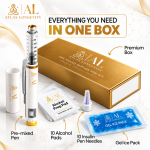
Included in the Box
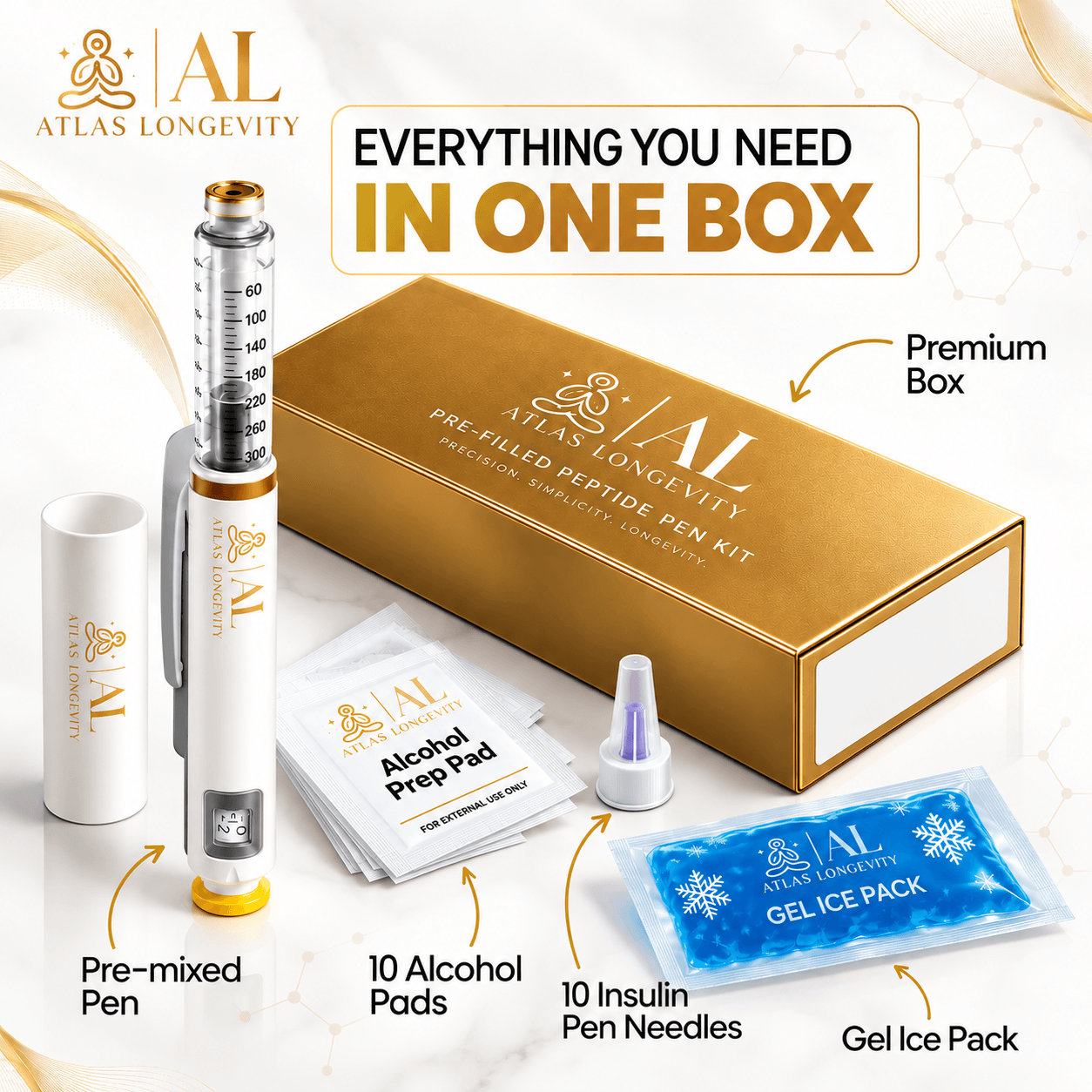
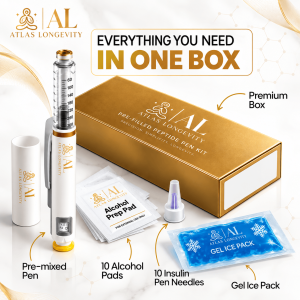
Each Atlas Longevity product is carefully packed to support secure storage, clean handling, and convenient research use. Inside the package, you’ll find the essential items needed for organized laboratory handling:
- 1× Ready-to-Use Injection Pen
- 10× Ultra-Fine Needles (33G, 4 mm)
- 10× Alcohol Prep Pads
- Protective Foam Insert to help keep the pen secure during transport
- Quick-Reference Instruction Panel inside the packaging
- Tamper-Evident Security Seal for added package protection
Each component is arranged in a clean, protective presentation designed to keep the product secure and easy to access.
Storage
Storage conditions should follow the instructions supplied with the specific Atlas Longevity CJC-1295 (No-DAC) + Ipamorelin formulation.
The reference source provides refrigeration and stability instructions for its own pre-mixed product, but those conditions should not automatically be transferred to an Atlas Longevity formulation without product-specific stability confirmation.
Follow the storage temperature, light-protection requirements, shelf-life information, and handling instructions printed on the Atlas Longevity product label or accompanying documentation.
Frequently Asked Questions
What is CJC-1295 (No-DAC) + Ipamorelin?
CJC-1295 (No-DAC) + Ipamorelin is a research peptide combination investigated for its effects on endogenous growth hormone signalling.
CJC-1295 (No-DAC) primarily acts through GHRH-related signalling, while Ipamorelin acts through the growth hormone secretagogue receptor.
How does CJC-1295 (No-DAC) + Ipamorelin work?
The compounds stimulate separate receptor pathways involved in growth hormone release.
CJC-1295 (No-DAC) activates GHRH receptors, while Ipamorelin primarily activates GHS-R1a receptors.
Researchers study the combination to understand whether dual-pathway stimulation can modify the timing or amplitude of GH release. Pasted text
What does “No-DAC” mean?
Within the supplied reference, the No-DAC form is described as a shorter-acting approach intended to produce more transient growth-hormone signalling rather than the prolonged activity associated with DAC-containing versions.
Is CJC-1295 (No-DAC) + Ipamorelin the same as growth hormone?
No.
Neither compound is human growth hormone itself.
They are researched for their ability to stimulate signalling pathways involved in the body’s endogenous release of growth hormone.
What is CJC-1295 (No-DAC) + Ipamorelin researched for?
Research areas described in the supplied material include:
- GH and IGF-1 signalling;
- endocrine pulsatility;
- muscle-recovery biology;
- collagen metabolism;
- connective-tissue research;
- adipose metabolism;
- body-composition signalling;
- metabolic regulation;
- regenerative research.
Not all of these areas have the same level of clinical evidence.
How much product is in the 5 mg + 5 mg Atlas Longevity pen?
The pen contains:
5 mg CJC-1295 (No-DAC)
plus:
5 mg Ipamorelin
for:
10 mg total peptide content in 3 mL.
How much product is in the 5 mg + 10 mg pen?
The pen contains:
5 mg CJC-1295 (No-DAC)
plus:
10 mg Ipamorelin
for:
15 mg total peptide content in 3 mL.
How many clicks are in each Atlas Longevity pen?
Each pen contains:
300 total clicks / units
and:
1 click = 0.01 mL
How much is one click of the 5 mg + 5 mg pen?
Each click contains approximately:
16.7 mcg CJC-1295 (No-DAC)
plus:
16.7 mcg Ipamorelin
for approximately:
33.3 mcg total peptide per click.
How much is one click of the 5 mg + 10 mg pen?
Each click contains approximately:
16.7 mcg CJC-1295 (No-DAC)
plus:
33.3 mcg Ipamorelin
for:
50 mcg total peptide per click.
How many clicks equal 0.5 mg total?
For the 5 mg + 5 mg pen:
15 clicks = 0.5 mg total
consisting of:
0.25 mg CJC-1295 + 0.25 mg Ipamorelin
For the 5 mg + 10 mg pen:
10 clicks = 0.5 mg total
consisting of approximately:
0.167 mg CJC-1295 + 0.333 mg Ipamorelin
These are concentration calculations rather than dosing recommendations.
How many clicks equal 1 mg total?
For the 5 mg + 5 mg pen:
30 clicks = 1 mg total
For the 5 mg + 10 mg pen:
20 clicks = 1 mg total
What is the maximum selectable amount on the pen?
The Atlas pen allows a maximum selection of:
60 clicks = 0.60 mL
For the 5 mg + 5 mg pen, this equals:
1 mg CJC-1295 + 1 mg Ipamorelin = 2 mg total
For the 5 mg + 10 mg pen, this equals:
1 mg CJC-1295 + 2 mg Ipamorelin = 3 mg total
This is a mechanical concentration calculation, not a recommended amount.
How long does the pen last?
Each Atlas Longevity pen contains 300 clicks.
The number of administrations mathematically available is:
300 ÷ number of clicks used each time
For example:
- 10 clicks at a time = 30 administrations
- 15 clicks at a time = 20 administrations
- 20 clicks at a time = 15 administrations
- 30 clicks at a time = 10 administrations
- 60 clicks at a time = 5 administrations
These examples describe cartridge capacity only.
Does the pen empty when the dial returns to zero?
No.
The dial returns to zero after administration, while the unused formulation remains inside the cartridge.
The remaining contents can continue to be selected until all 300 pen units have been used.
Have CJC-1295 and Ipamorelin been studied in humans?
The supplied reference identifies human research relating to growth hormone secretagogues and CJC-1295-related compounds alongside animal and laboratory research. Pasted text
However, evidence involving one component or another CJC formulation should not automatically be treated as clinical evidence for the exact CJC-1295 (No-DAC) + Ipamorelin combination.
Is CJC-1295 (No-DAC) + Ipamorelin approved for anti-ageing or muscle growth?
The supplied information does not establish regulatory therapeutic approval for those uses.
Research into GH, IGF-1, body composition, recovery, and ageing-related biology should not be interpreted as approval for treatment.
How should the pen be stored?
Follow the storage instructions supplied specifically with the Atlas Longevity formulation.
Although the reference product provides refrigeration instructions for its own pre-mixed pen, Atlas-specific temperature and stability claims should be based on the actual Atlas formulation rather than copied from another supplier.
Related products
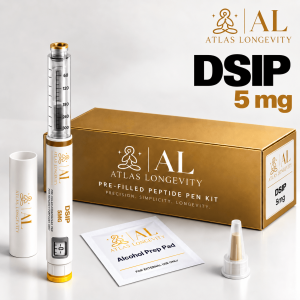
DSIP Pen
Price range: Rp1,300,000.00 through Rp3,100,000.00 ~$78.79–$187.88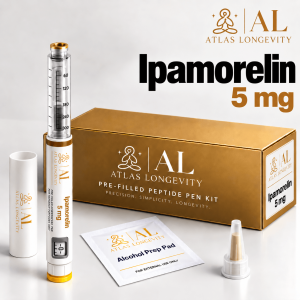
Ipamorelin Pen
Price range: Rp1,200,000.00 through Rp2,600,000.00 ~$72.73–$157.58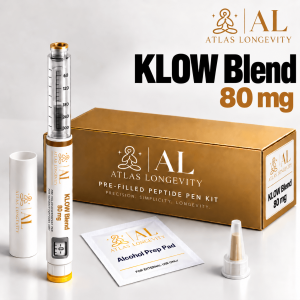
KLOW 80mg Pen (GHK-Cu + KPV + BPC-157 + TB-500)
Price range: Rp3,200,000.00 through Rp3,800,000.00 ~$193.94–$230.30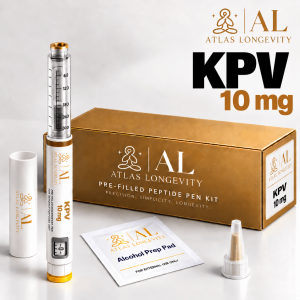
KPV 10mg Pen
Price range: Rp1,500,000.00 through Rp2,100,000.00 ~$90.91–$127.27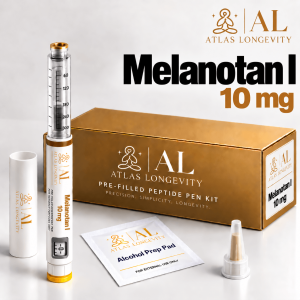
Melanotan I 10mg Pen
Price range: Rp2,500,000.00 through Rp3,100,000.00 ~$151.52–$187.88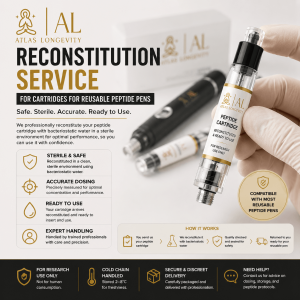
Reconstitution Service for Reusable Peptide Pen Cartridges
Rp250,000.00 ~$15.15
 Peptide Vials
 Peptide Nasal Sprays
 Peptide Protocols
 Bundles