
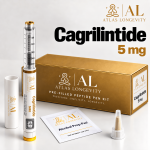



Cagrilintide 5mg
Price range: Rp2,000,000.00 through Rp2,600,000.00 ~$121.21–$157.58
Cagrilintide is a synthetic long-acting analogue of amylin, a hormone normally co-secreted with insulin by pancreatic beta cells.
Amylin participates in the regulation of satiety, meal size, gastric emptying, postprandial glucose handling, and energy intake. Cagrilintide has been structurally modified to provide substantially longer biological activity than native amylin, allowing sustained investigation of amylin-receptor signalling.
Human clinical research has examined Cagrilintide in relation to:
- appetite regulation;
- reduced energy intake;
- body-weight change;
- obesity research;
- gastric-emptying physiology;
- metabolic regulation;
- combination incretin-based research.
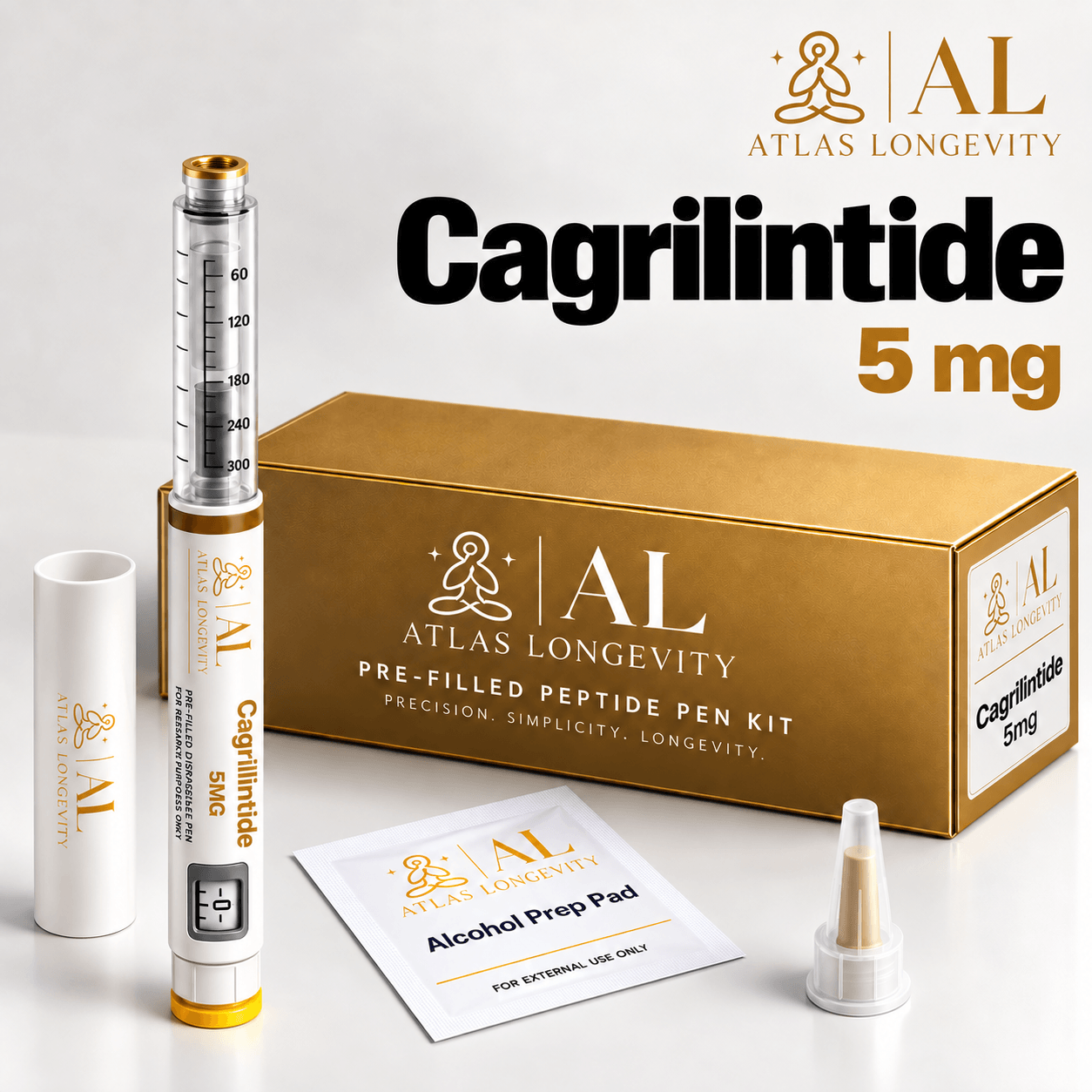
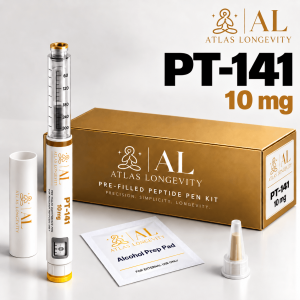
The Atlas Longevity Cagrilintide pen contains 5 mg in a 3 mL cartridge with 300 total units/clicks.
Cagrilintide remains an investigational metabolic compound within the material supplied. Human clinical evidence exists, but the source does not establish general regulatory approval for the Atlas Longevity formulation or for routine weight-management treatment.
Clinical / Research Status
Cagrilintide has progressed into substantial human clinical investigation, particularly in overweight, obesity, and metabolic research.
| Evidence Type | Status Based on Supplied Material |
|---|---|
| Human randomized clinical research | Yes |
| Human observational research | Yes |
| Animal research | Yes |
| In-vitro research | Yes |
| General regulatory approval | Not established by supplied material |
The source describes multiple human studies examining Cagrilintide alone and in combination with GLP-1-related compounds.
Human research provides more direct evidence than exists for many experimental peptides, but findings remain formulation-, population-, and protocol-specific.
Evidence Type
The supplied material describes research involving:
- Phase 1b studies in adults with overweight or obesity;
- human satiety studies;
- metabolic profiling;
- combination research with GLP-1 SMA;
- diet-induced obesity animal models;
- amylin-receptor binding assays.
The strongest source-supported areas are appetite regulation, satiety, food-intake reduction, and body-weight research.
Claims involving broader metabolic optimisation should remain secondary to those established research domains.
Mechanism of Action
Cagrilintide acts primarily as a long-acting amylin receptor agonist.
Amylin receptors are not single standalone receptors. They are formed from combinations of:
- the calcitonin receptor;
- receptor activity-modifying proteins (RAMPs).
These receptor complexes are expressed in areas of the nervous system involved in appetite and satiety regulation.
Central Satiety Signalling
Cagrilintide activates amylin-sensitive signalling in brain regions including the:
- area postrema;
- brainstem;
- hypothalamic appetite-control networks.
These regions integrate circulating nutrient-related signals and contribute to:
- meal termination;
- fullness;
- hunger regulation;
- energy intake.
Gastric Emptying
Amylin signalling also influences gastrointestinal motility.
Slower gastric emptying can alter:
- nutrient delivery;
- post-meal glucose appearance;
- duration of fullness;
- postprandial satiety.
Long-Acting Design
Native amylin is cleared relatively quickly.
Cagrilintide has been engineered for prolonged activity, allowing substantially more sustained receptor engagement and making it useful in longer-duration metabolic research.
Potential Benefits / Research Areas
Satiety and Appetite Research
Cagrilintide is primarily investigated for its influence on physiological satiety pathways rather than stimulant-style appetite suppression.
Activation of amylin receptors influences central circuits involved in:
- hunger;
- fullness;
- meal size;
- food-seeking behaviour.
This is one of the principal mechanistic foundations of Cagrilintide research.
Energy-Intake Research
Human studies have examined whether sustained amylin signalling can reduce overall energy intake.
The mechanism appears to act upstream by altering appetite and meal-related signalling rather than directly increasing metabolic rate.
Body-Weight Research
Clinical research has examined Cagrilintide in adults with overweight or obesity.
The supplied source reports body-weight reductions in selected controlled studies, including substantial changes over multi-month research periods.
These study-specific findings should not be interpreted as guaranteed results for every population or formulation.
Gastric-Emptying Research
Cagrilintide is also relevant to research involving:
- delayed gastric emptying;
- prolonged postprandial fullness;
- nutrient-delivery kinetics;
- post-meal metabolic responses.
This peripheral mechanism complements its central satiety activity.
Postprandial Metabolic Research
Amylin is naturally co-secreted with insulin.
Research therefore examines how Cagrilintide-related amylin signalling interacts with:
- nutrient processing;
- postprandial glucose regulation;
- pancreatic signalling;
- energy homeostasis.
Amylin Receptor Biology
Cagrilintide provides a model for investigating signalling through calcitonin receptor/RAMP complexes.
This includes research into:
- receptor specificity;
- ligand binding;
- sustained receptor activation;
- neural appetite circuitry.
Combination Incretin Research
A major area of interest involves combining amylin signalling with incretin pathways.
GLP-1 receptor agonism and amylin receptor agonism influence energy intake through overlapping but distinct mechanisms.
The supplied source specifically discusses combination research with GLP-1 SMA, including the investigational CagriSema concept.
Research Data
| Study / Model | Reported Finding |
|---|---|
| Phase 1b study in adults with overweight/obesity | Body-weight reduction reported over 26 weeks, with the source citing up to 10.8% at a 4.5 mg research level |
| Cagrilintide + GLP-1 SMA research | Greater changes in body weight and glycaemic markers than GLP-1 SMA alone in selected studies |
| Diet-induced obesity animal models | Reduced food intake, reduced adiposity and changes in leptin-related signalling |
| Human satiety studies | Delayed gastric emptying and prolonged postprandial fullness |
| Amylin-receptor binding assays | Sustained receptor activation compared with native amylin |
| Metabolic profiling | Changes in glycaemic and lipid-related markers alongside weight reduction |
These findings come from different research settings and should not all be interpreted as equivalent evidence for the Atlas Longevity pen.
Potential Stack / Combination Research
The supplied material discusses experimental combinations involving:
- Cagrilintide + GLP-1 SMA;
- Cagrilintide + GLP-2 TRZ;
- Cagrilintide + GLP-3 RTA;
- Cagrilintide + AOD-9604.
The strongest clinical rationale among those listed relates to Cagrilintide + GLP-1 SMA, because this combination has been directly investigated in human clinical research.
The other combinations should be treated more cautiously.
Combining Cagrilintide with incretin-based compounds could produce overlapping effects involving:
- appetite;
- gastrointestinal function;
- glucose regulation;
- body-weight change.
The supplied material does not establish validated safety, compatibility, efficacy, or dosing for every proposed combination.
They should therefore remain experimental research concepts rather than recommended stacks.
Atlas Longevity Cagrilintide Pen Dosage / Click Chart
The Atlas Longevity Cagrilintide pen contains:
5 mg Cagrilintide
3 mL cartridge volume
300 total clicks
1 click = 0.01 mL
Maximum selectable dial amount = 60 clicks
Pen Specification
| Pen Strength | Volume | Concentration | Amount Per Click |
|---|---|---|---|
| 5 mg | 3 mL | ≈1.667 mg/mL | ≈0.0167 mg / 16.7 mcg |
Concentration Calculation
5 mg ÷ 3 mL = 1.6667 mg/mL
Rounded:
≈1.667 mg/mL
Amount Per Click
5 mg ÷ 300 clicks = 0.016667 mg
Therefore:
1 click ≈0.0167 mg
or:
≈16.7 mcg Cagrilintide
Cagrilintide Click Conversion Chart
| Clicks | Volume | Cagrilintide Amount |
|---|---|---|
| 1 | 0.01 mL | ≈0.0167 mg / 16.7 mcg |
| 5 | 0.05 mL | ≈0.0833 mg |
| 10 | 0.10 mL | ≈0.1667 mg |
| 15 | 0.15 mL | 0.250 mg |
| 18 | 0.18 mL | 0.300 mg |
| 20 | 0.20 mL | ≈0.333 mg |
| 30 | 0.30 mL | 0.500 mg |
| 36 | 0.36 mL | 0.600 mg |
| 40 | 0.40 mL | ≈0.667 mg |
| 45 | 0.45 mL | 0.750 mg |
| 50 | 0.50 mL | ≈0.833 mg |
| 60 | 0.60 mL | 1.000 mg |
Useful Conversions
- 15 clicks = 0.25 mg
- 18 clicks = 0.30 mg
- 30 clicks = 0.50 mg
- 36 clicks = 0.60 mg
- 60 clicks = 1 mg
The maximum selectable amount in one dial operation is:
60 clicks = 0.60 mL = 1 mg Cagrilintide
This is a mathematical concentration conversion and not a dosing recommendation.
Protocol / Dosage Information
The supplied source describes experimental quantities ranging approximately from 0.3 mg to 2.4 mg in its proposed research protocols.
Its original click calculations were based on a 5 mg / 2 mL formulation, so those click values do not apply to the Atlas Longevity 3 mL system.
Using the Atlas 5 mg / 3 mL / 300-click formulation:
| Source-Referenced Amount | Atlas Pen Mathematical Equivalent |
|---|---|
| 0.30 mg | 18 clicks |
| 0.60 mg | 36 clicks |
| 1.00 mg | 60 clicks |
| 1.20 mg | 72 total clicks |
| 1.80 mg | 108 total clicks |
| 2.40 mg | 144 total clicks |
| 4.50 mg | 270 total clicks |
Important Pen Limitation
The Atlas pen allows a maximum of:
60 clicks per single dial operation
Therefore:
1 mg = maximum amount selectable in one dial operation
while:
- 1.2 mg = 72 clicks mathematically;
- 1.8 mg = 108 clicks mathematically;
- 2.4 mg = 144 clicks mathematically;
- 4.5 mg = 270 clicks mathematically.
Those higher quantities cannot be selected as one dial amount.
They are shown only to translate research quantities appearing in the source into Atlas concentration mathematics.
They are not instructions to divide, repeat, or administer multiple injections.
The source’s weekly schedules, escalation plans, treatment durations, and cycling suggestions should not be copied into Atlas content as self-administration guidance.
Possible Side Effects
Human clinical research described in the supplied material reports adverse effects primarily involving the gastrointestinal system.
These include:
- nausea;
- vomiting;
- gastrointestinal discomfort;
- constipation;
- altered bowel habits;
- decreased appetite;
- injection-site redness or irritation;
- fatigue;
- headache.
Gastrointestinal Effects
Because Cagrilintide influences satiety pathways and gastric emptying, gastrointestinal effects are biologically consistent with its mechanism.
Nausea appears particularly relevant during changes in exposure.
Appetite Reduction
Reduced appetite is an intended research endpoint in many Cagrilintide studies but can also be regarded as an adverse effect depending on the research context and magnitude.
Long-Term Safety
The supplied material states that severe hepatic, renal, or cardiovascular adverse effects were not identified in the clinical data it references.
This should not be interpreted as proof that such risks are impossible.
Long-term safety considerations remain important, particularly regarding:
- prolonged gastrointestinal effects;
- excessive reduction in energy intake;
- metabolic interactions;
- combination incretin therapy;
- glucose-related changes;
- long-term exposure;
- pregnancy or reproductive exposure.
Product Attributes
| Attribute | Information |
|---|---|
| Compound Name | Cagrilintide |
| Development Names | AM833, NN9838 |
| CAS Number | 1415456-99-3 |
| Molecular Formula | C171H266N42O55S2 |
| Amino Acid Sequence listed by source | KCNTATCATQRLANFLVHSSNNFGAILSSTNVGSNTY |
| Molecular Weight | Approximately 3789 g/mol |
| Half-Life listed by source | Approximately 159 hours / ~7 days |
| Compound Type | Long-acting synthetic amylin analogue |
| Primary Target | Amylin receptor complexes |
| Research Focus | Appetite, satiety, obesity and metabolic regulation |
The technical specifications above are based on the supplied source material.
Atlas should confirm the precise sequence, chemical modifications, salt form, and final analytical specifications against the actual Certificate of Analysis before publication, particularly because long-acting peptide analogues may contain structural modifications not fully represented by a simple amino-acid sequence.
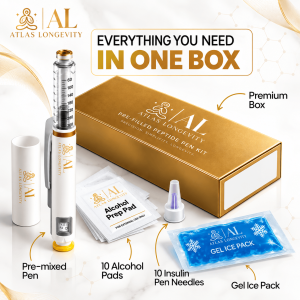
Included in the Box
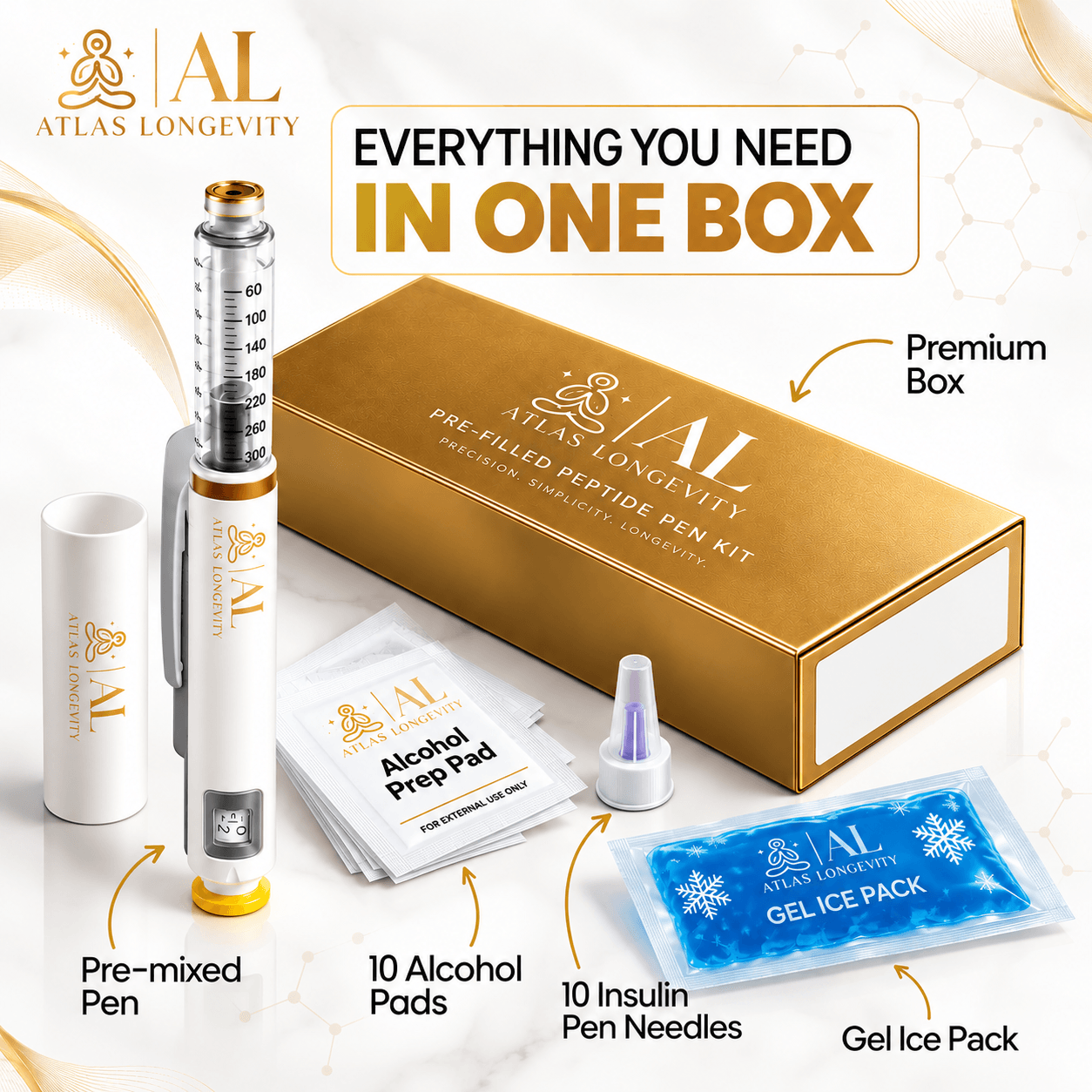
Each Atlas Longevity product is carefully packed to support secure storage, clean handling, and convenient research use. Inside the package, you’ll find the essential items needed for organized laboratory handling:
- 1× Ready-to-Use Injection Pen
- 10× Ultra-Fine Needles (33G, 4 mm)
- 10× Alcohol Prep Pads
- Protective Foam Insert to help keep the pen secure during transport
- Quick-Reference Instruction Panel inside the packaging
- Tamper-Evident Security Seal for added package protection
Each component is arranged in a clean, protective presentation designed to keep the product secure and easy to access.
Storage
Storage conditions should follow the instructions supplied specifically with the Atlas Longevity Cagrilintide formulation.
The reference source provides refrigeration and stability specifications for its own formulation. Those conditions should not automatically be transferred to an Atlas Longevity formulation without product-specific stability data.
Follow the temperature requirements, light-protection guidance, shelf-life information, and handling instructions shown on the Atlas Longevity product label or accompanying documentation.
Frequently Asked Questions
What is Cagrilintide?
Cagrilintide is a synthetic long-acting amylin analogue investigated mainly for appetite regulation, satiety, energy-intake reduction, body-weight research, and metabolic signalling.
What is amylin?
Amylin is a hormone normally co-secreted with insulin by pancreatic beta cells.
It contributes to:
- satiety;
- meal-size regulation;
- gastric emptying;
- postprandial metabolic control.
How does Cagrilintide work?
Cagrilintide activates amylin receptor complexes in central nervous system regions involved in satiety and appetite regulation.
It also influences gastric emptying, which can prolong fullness and alter post-meal nutrient delivery.
Where are amylin receptors located?
Important sites include the area postrema and hypothalamic appetite-regulation pathways.
These regions help integrate circulating nutrient signals with central hunger and satiety responses.
What are RAMPs?
RAMPs are receptor activity-modifying proteins.
Amylin receptors are formed when calcitonin receptors associate with particular RAMP proteins.
These combinations alter receptor pharmacology and ligand specificity.
Is Cagrilintide a GLP-1 receptor agonist?
No.
Cagrilintide is primarily an amylin analogue, not a GLP-1 receptor agonist.
However, amylin and GLP-1 pathways can influence overlapping aspects of appetite and energy regulation.
Is Cagrilintide the same as GLP-1 SMA?
No.
Cagrilintide primarily targets amylin receptor systems, while GLP-1 SMA acts through the GLP-1 receptor.
The two have been investigated together because they affect energy balance through distinct but complementary pathways.
What is CagriSema?
The supplied material uses CagriSema to describe research involving Cagrilintide together with GLP-1 SMA.
Combination-study findings should not automatically be applied to Cagrilintide alone.
What is Cagrilintide researched for?
Major research areas include:
- satiety;
- appetite;
- energy intake;
- body weight;
- obesity;
- gastric emptying;
- glucose-related metabolism;
- combination incretin research.
Has Cagrilintide been studied in humans?
Yes.
The supplied material describes multiple controlled human trials involving overweight, obesity, metabolic regulation, and combination therapy.
Does Cagrilintide reduce body weight?
Human clinical research described in the source reports body-weight reductions in selected study populations.
Those results are specific to particular trial designs, doses, durations, and populations and should not be treated as guaranteed outcomes.
Does Cagrilintide slow gastric emptying?
Amylin receptor activation can slow gastric emptying.
The supplied source discusses delayed gastric emptying and prolonged postprandial fullness as part of Cagrilintide’s research profile.
Does Cagrilintide suppress appetite?
Appetite and satiety regulation are major research endpoints for Cagrilintide.
Its mechanism involves physiological satiety pathways rather than stimulant-mediated appetite suppression.
How much Cagrilintide is in each Atlas Longevity pen?
Each Atlas Longevity Cagrilintide pen contains:
5 mg in 3 mL.
What is the concentration of the Cagrilintide pen?
The concentration is:
5 mg ÷ 3 mL = approximately 1.667 mg/mL
How many clicks are in the pen?
Each Atlas Longevity Cagrilintide pen contains:
300 total clicks / units
with:
1 click = 0.01 mL
How much Cagrilintide is in one click?
Each click contains approximately:
0.0167 mg
or:
16.7 mcg Cagrilintide
How many clicks equal 0.25 mg?
15 clicks = 0.25 mg.
How many clicks equal 0.3 mg?
18 clicks = 0.30 mg.
How many clicks equal 0.5 mg?
30 clicks = 0.50 mg.
How many clicks equal 0.6 mg?
36 clicks = 0.60 mg.
How many clicks equal 1 mg?
60 clicks = 1 mg.
These values are mathematical concentration conversions rather than dosing recommendations.
How many clicks equal 1.2 mg?
Mathematically:
1.2 mg = 72 clicks
This exceeds the Atlas pen’s 60-click maximum single dial selection.
It therefore cannot be selected as one dial amount.
This is a concentration calculation only and does not provide instructions for administering that quantity.
How many clicks equal 2.4 mg?
Mathematically:
2.4 mg = 144 clicks
This exceeds the maximum single dial setting and is shown only to translate a research quantity mentioned in the supplied source.
What is the maximum selectable amount on the Cagrilintide pen?
The maximum single dial selection is:
60 clicks
which equals:
0.60 mL
and:
1 mg Cagrilintide
This is the mechanical limit of the pen rather than a recommended research quantity.
How long does a Cagrilintide pen last?
The complete pen contains:
300 clicks and 5 mg Cagrilintide.
For cartridge-capacity calculations only:
- 10 clicks at a time = 30 administrations
- 15 clicks at a time = 20 administrations
- 20 clicks at a time = 15 administrations
- 30 clicks at a time = 10 administrations
- 60 clicks at a time = 5 administrations
These examples describe cartridge capacity only.
Does the medication disappear when the dial returns to zero?
No.
After administration, the dial returns to zero while unused formulation remains inside the cartridge.
The remaining Cagrilintide stays in the pen until all 300 units have been used.
What is the half-life of Cagrilintide?
The supplied source lists an approximate half-life of:
159 hours, or roughly seven days.
That value should be understood as source-reported pharmacokinetic information and should not automatically be treated as formulation-specific data for every finished product.
Can Cagrilintide be combined with GLP-1 SMA?
The supplied material describes human research involving Cagrilintide together with GLP-1 SMA.
However, combination-study protocols and results should not be converted into unsupervised use instructions.
Can Cagrilintide be combined with GLP-2 TRZ or GLP-3 RTA?
The source discusses these as experimental combination concepts.
Validated safety, compatibility, efficacy, and dosing for those specific combinations are not established by the supplied information.
Is there an established dosage for the Atlas Cagrilintide pen?
The supplied source describes research quantities, but the original click calculations use a different formulation.
The Atlas click chart therefore represents concentration mathematics only, not a treatment recommendation.
How should the Atlas Longevity Cagrilintide pen be stored?
Follow the storage instructions supplied specifically with the actual Atlas Longevity formulation.
The reference manufacturer’s refrigeration and stability claims relate to its own finished product and should not automatically be transferred to Atlas without product-specific stability evidence.
Related products
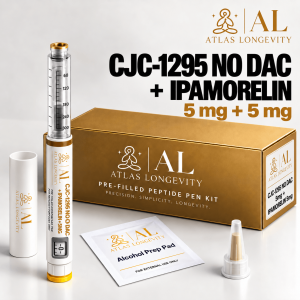
CJC-1295 No DAC 5mg + Ipamorelin 5mg Pen
Price range: Rp1,900,000.00 through Rp2,500,000.00 ~$115.15–$151.52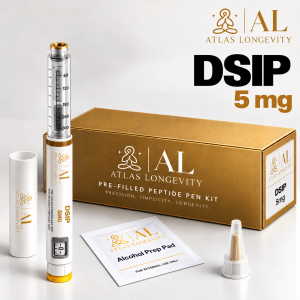
DSIP Pen
Price range: Rp1,300,000.00 through Rp2,600,000.00 ~$78.79–$157.58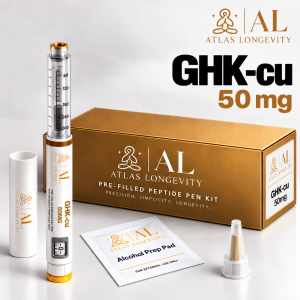
GHK-Cu Peptide Pen
Price range: Rp1,400,000.00 through Rp3,000,000.00 ~$84.85–$181.82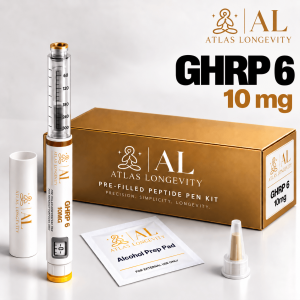
GHRP 6 10MG
Price range: Rp1,900,000.00 through Rp2,500,000.00 ~$115.15–$151.52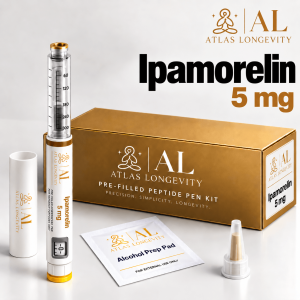
Ipamorelin Pen
Price range: Rp1,200,000.00 through Rp2,600,000.00 ~$72.73–$157.58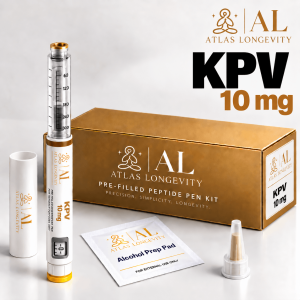
KPV 10mg Pen
Price range: Rp1,500,000.00 through Rp2,100,000.00 ~$90.91–$127.27
 Peptide Vials
 Peptide Nasal Sprays
 Peptide Protocols
 Bundles