
Blog
How to Reconstitute Peptides: Ultimate Guide to Safe Dilution


Introduction
How to reconstitute peptides is a common question among people researching peptide products, laboratory supplies, or scientific literature. In simple terms, peptide reconstitution refers to converting a freeze-dried (lyophilised) peptide into a liquid solution using an appropriate sterile diluent. While the concept sounds straightforward, the process requires careful handling, appropriate training, and strict adherence to the manufacturer’s instructions and relevant regulations.
Most peptides are supplied in a dry, stable form because this helps preserve their quality during transport and storage. Once a peptide is prepared as a solution, factors such as sterility, temperature, handling, and storage conditions become increasingly important. Understanding these principles can help reduce the risk of contamination and support product integrity.
This guide explains what peptide reconstitution means, why it matters, the equipment and considerations involved, common mistakes to avoid, and best practices for handling reconstituted peptides. Rather than providing procedural instructions, the focus is on helping readers understand the underlying principles so they can make informed decisions and follow the guidance supplied by the product manufacturer or relevant healthcare or laboratory professionals.
What Does It Mean to Reconstitute Peptides?
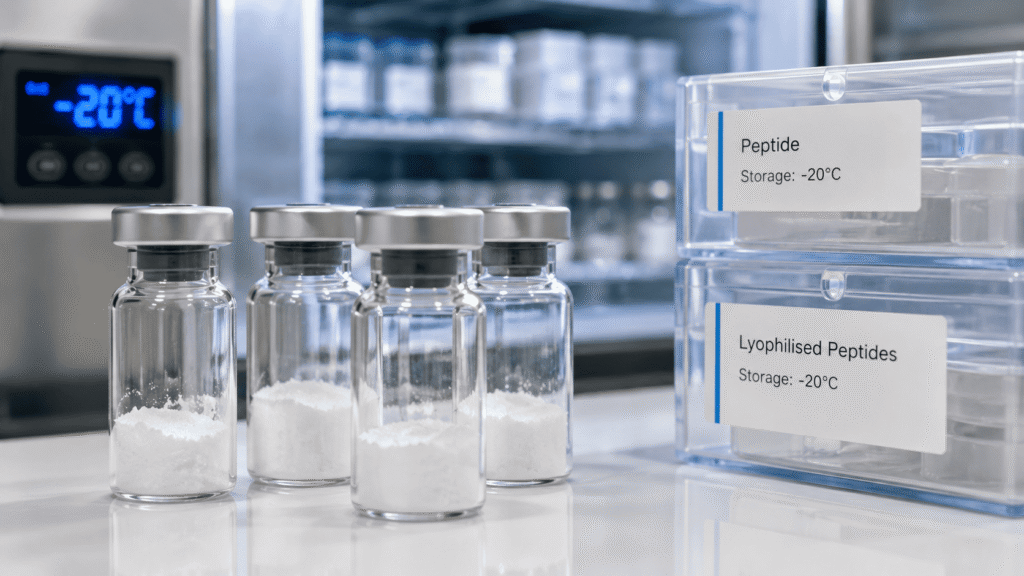
Understanding Peptide Reconstitution
Peptide reconstitution is the process of returning a freeze-dried peptide to a liquid form using an appropriate sterile diluent. Freeze-drying, also known as lyophilisation, removes water from the peptide while helping preserve its stability during storage and transportation.
Once reconstituted, the peptide becomes a solution that may be suitable for its intended research or clinical purpose, depending on the product and applicable regulations. Because the peptide is no longer in its most stable dry form, correct handling and storage become much more important.
In scientific and laboratory settings, peptide reconstitution is treated as a controlled preparation step rather than a routine mixing task. Accuracy, cleanliness, and following documented procedures all contribute to maintaining product quality.
Why Proper Dilution Matters
Proper dilution is important because it affects both the quality and consistency of the prepared solution. Using the correct diluent and following the manufacturer’s instructions helps support:
- Accurate concentration
- Product stability
- Reduced contamination risk
- Reliable research outcomes
- Consistent handling procedures
Even small deviations can affect solution quality, which is why laboratories typically follow detailed standard operating procedures (SOPs).
Common Liquids Used for Reconstitution
Different peptide products may recommend different sterile diluents depending on their formulation.
Common examples include:
- Bacteriostatic water
- Sterile water for injection
- Other manufacturer-approved sterile diluents
The appropriate choice depends entirely on the product’s instructions. Substituting one diluent for another without guidance may affect stability or suitability.
Before You Begin: Equipment and Preparation
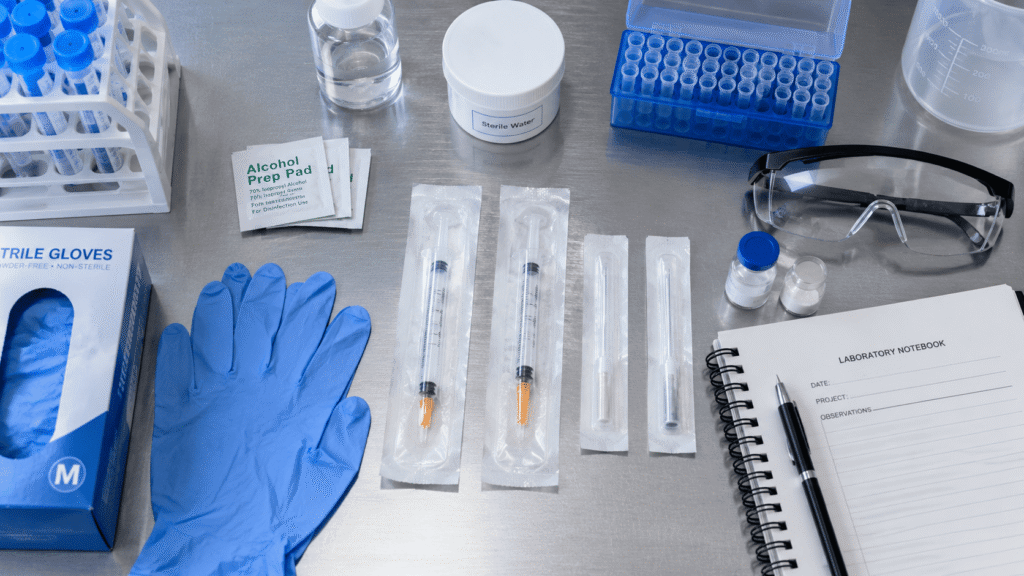
Essential Supplies
Preparing peptides begins with using clean, appropriate equipment. Typical laboratory supplies include:
- Lyophilised peptide vial
- Manufacturer-recommended sterile diluent
- Sterile syringe and needle
- Alcohol swabs
- Disposable gloves
- Clean workspace
- Labels for identification and dating
Using sterile, single-use equipment helps minimise contamination risks.
Creating a Clean Working Environment
Maintaining a clean workspace is one of the most important aspects of peptide handling.
Good laboratory practice includes:
- Cleaning work surfaces before preparation
- Avoiding unnecessary handling
- Keeping containers sealed until needed
- Wearing appropriate protective equipment where required
These practices reduce opportunities for microorganisms or foreign particles to enter the solution.
Reading the Product Instructions
Before handling any peptide, carefully review the manufacturer’s documentation.
Pay particular attention to:
- Product concentration
- Recommended diluent
- Storage requirements
- Expiry dates
- Handling precautions
- Intended use
Product instructions should always take precedence over general information found online.
Step-by-Step Guide to Reconstituting Peptides
Understanding how to reconstitute peptides starts with recognising that the exact preparation method varies between products. Rather than relying on a universal procedure, the safest approach is to follow the instructions supplied with the specific peptide.
The following checklist outlines good preparation practices that apply broadly without replacing manufacturer guidance.
The Reconstitution Process
- Review the product documentation. Confirm the recommended preparation method, storage conditions, and intended use before opening the vial.
- Prepare a clean workspace. Work in a clean environment using sterile equipment and appropriate hygiene practices.
- Inspect all materials. Check that the vial, packaging, and diluent are undamaged and within their expiry dates.
- Use only the recommended diluent. Follow the manufacturer’s instructions regarding compatible sterile diluents.
- Handle the peptide gently. Avoid unnecessary agitation or rough handling, as some peptide formulations may be sensitive.
- Label the prepared product. Record relevant information such as the preparation date if recommended by your laboratory or workplace procedures.
- Store according to instructions. Follow the manufacturer’s guidance regarding refrigeration, protection from light, and shelf life after preparation.
Tips for Best Results
- Always follow manufacturer guidance.
- Use sterile, single-use equipment where appropriate.
- Minimise unnecessary handling.
- Keep preparation areas clean.
- Maintain accurate documentation.
Section recap
- Product instructions are the primary source of guidance.
- Clean handling practices help protect product quality.
- Consistency is more important than speed.
Understanding Peptide Concentration and Dilution
Peptide concentration describes the amount of peptide present within a given volume of solution. Understanding this concept is important because different products are designed for different concentrations and intended applications.
Concentration affects how researchers interpret results and maintain consistency across experiments. It is not simply about adding liquid to powder; it involves achieving the concentration specified by the manufacturer or research protocol.
Example Dilution Table
| Lyophilised Peptide | Example Diluent Volume* | Example Concentration* | General Purpose |
|---|---|---|---|
| 2 mg | Varies by manufacturer | Varies | Research use |
| 5 mg | Varies by manufacturer | Varies | Research use |
| 10 mg | Varies by manufacturer | Varies | Research use |
*Illustrative only. Actual preparation instructions vary between products and manufacturers.
Common Dilution Mistakes
Common issues include:
- Assuming all peptides are prepared the same way
- Ignoring product-specific instructions
- Using unsuitable or unapproved diluents
- Poor labelling practices
- Inadequate storage after preparation
Many quality issues stem from inconsistent handling rather than problems with the peptide itself.
Storage, Handling and Shelf Life After Reconstitution
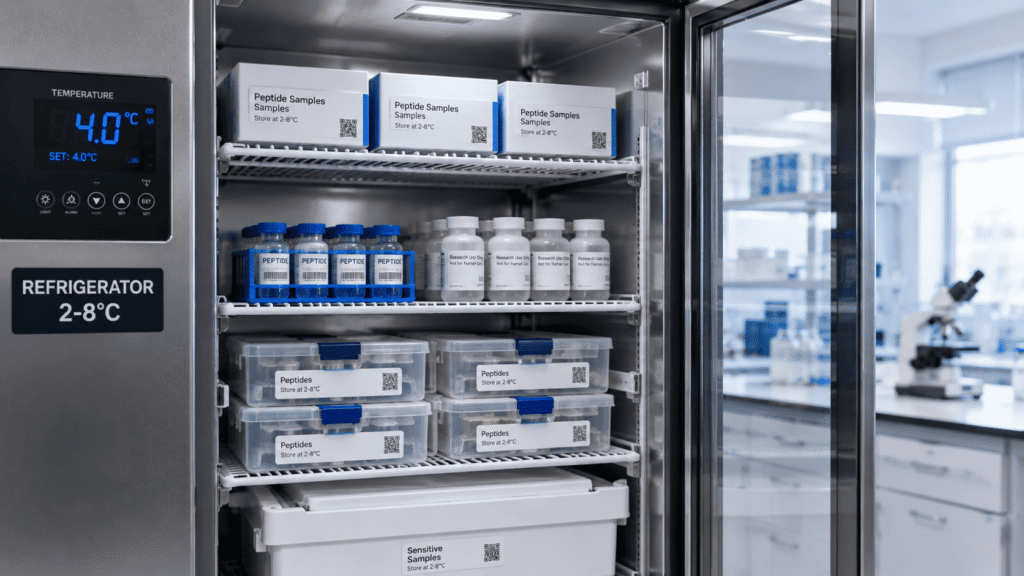
Once prepared, peptides generally require more careful storage than when they are in their freeze-dried form.
Recommended Storage Practices
Although storage requirements differ between products, common recommendations may include:
- Refrigeration where specified
- Protection from excessive heat
- Avoiding prolonged exposure to light
- Keeping containers sealed
- Preventing unnecessary temperature fluctuations
Always refer to the manufacturer’s instructions for the specific product.
Signs a Peptide May No Longer Be Suitable
A prepared peptide solution should be evaluated according to manufacturer guidance.
Potential warning signs may include:
- Unexpected cloudiness
- Visible particles
- Colour changes
- Damaged containers
- Storage beyond the recommended period
If there is uncertainty regarding product integrity, it should not be used for its intended purpose.
Handling Tips to Maintain Quality
Good handling practices include:
- Limiting unnecessary movement of the vial
- Maintaining sterile technique
- Keeping accurate records
- Following workplace SOPs
- Monitoring storage conditions
These practices help support consistency and traceability within research environments.
Real-World Applications and Common Mistakes

Example Scenario: Maintaining Consistency in a Research Setting
A university research laboratory receives multiple peptide samples for a long-term study.
Instead of relying on memory or online advice, the laboratory team follows its documented SOPs and the manufacturer’s instructions for each product. Every vial is labelled, preparation records are maintained, and storage conditions are monitored throughout the project.
As a result, researchers minimise variation between samples and improve confidence in the reproducibility of their experimental data.
Why Consistency Matters for Small Businesses
Small businesses involved in scientific supply, laboratory services, or professional training also benefit from standardised peptide handling practices.
Examples include:
- Research laboratories
- Educational training providers
- Scientific distributors
- Laboratory consultancy businesses
Benefits include:
- Improved quality assurance
- Better staff training
- Reduced handling errors
- Stronger customer confidence
- Easier regulatory compliance
Industry expectations continue to place greater emphasis on documentation, traceability, and quality management systems, making consistent procedures increasingly valuable.
Mistakes That Can Affect Peptide Quality
Some of the most common mistakes include:
- Failing to read the manufacturer’s documentation
- Using inappropriate equipment
- Poor hygiene during handling
- Incorrect storage conditions
- Inadequate record keeping
Section recap
- Standard operating procedures improve consistency.
- Documentation supports quality assurance.
- Small businesses benefit from repeatable handling practices.
Key Takeaways for Safe and Accurate Peptide Reconstitution
Understanding how to reconstitute peptides is about more than simply preparing a solution. It involves recognising the importance of sterility, appropriate equipment, product-specific guidance, and proper storage.
Key points include:
- Peptides are commonly supplied in freeze-dried form for improved stability.
- Manufacturer instructions should always guide preparation and storage.
- Clean handling practices reduce contamination risks.
- Accurate documentation supports consistency.
- Standard operating procedures improve quality across laboratories and businesses.
A careful, consistent approach helps maintain product integrity while supporting reliable research outcomes.
Learn More About Peptide Handling and Best Practices
Peptide science continues to evolve, with increasing interest in laboratory research, pharmaceutical development, and educational training. As this field grows, understanding good handling practices becomes even more valuable.
If you would like to expand your knowledge, consider exploring topics such as:
- What peptides are and how they work
- Why peptides are supplied in lyophilised form
- Peptide storage best practices
- Laboratory quality assurance
- Scientific documentation and SOPs
Building a strong understanding of these fundamentals provides a solid foundation for responsible peptide handling.
FAQ
What does it mean to reconstitute peptides?
Peptide reconstitution means converting a freeze-dried peptide into a liquid solution using an appropriate sterile diluent. The exact method depends on the manufacturer’s instructions.
Why are peptides supplied as freeze-dried powder?
Freeze-drying helps improve stability during storage and transport by removing moisture, which can reduce degradation over time.
Can all peptides be reconstituted the same way?
No. Different peptide formulations have different preparation requirements. Always follow the documentation provided with the specific product.
What is the difference between bacteriostatic water and sterile water for peptide reconstitution?
Both are sterile products, but they have different characteristics and intended uses. The appropriate choice depends on the manufacturer’s recommendations for the specific peptide.
How should reconstituted peptides be stored?
Storage requirements vary by product, but many manufacturers recommend protecting prepared peptides from heat, light, and inappropriate temperatures. Always follow the supplied instructions.
How long do reconstituted peptides typically remain stable?
There is no universal shelf life. Stability depends on the peptide formulation, storage conditions, and manufacturer guidance.
Why should peptides be handled carefully?
Careful handling helps reduce contamination risks and supports product quality throughout storage and use.
What are the most common mistakes when reconstituting peptides?
Common mistakes include ignoring product instructions, poor hygiene practices, incorrect storage, inadequate documentation, and assuming every peptide follows the same preparation requirements.
Keeping Safe Practices at the Centre of Peptide Handling
Understanding how to reconstitute peptides begins with understanding why careful preparation matters. While individual products have different requirements, the underlying principles remain consistent: follow manufacturer guidance, maintain sterility, store products appropriately, and document handling accurately.
Whether you work in research, education, or scientific supply, applying consistent handling practices helps protect product quality and supports reliable outcomes. As peptide research continues to expand, maintaining these standards will remain an essential part of responsible laboratory practice.
Continue Building Your Knowledge of Peptide Best Practices
If you’re researching how to reconstitute peptides, use this article as a foundation and always refer to the official documentation supplied with your specific product. Expanding your understanding of peptide storage, handling, and quality assurance will help you make informed decisions and support safe, consistent practices.
 Peptide Vials
 Peptide Pens
 Peptide Nasal Sprays
 Peptide Protocols
 Bundles