
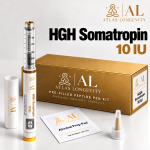
HGH Somatropin
Price range: Rp1,500,000.00 through Rp7,300,000.00 ~$90.91–$442.42
Somatropin (recombinant human growth hormone / rhGH) is a 191-amino-acid peptide hormone designed to match endogenous human growth hormone produced by the pituitary gland.
Growth hormone plays a central role in growth, metabolism, tissue turnover, protein synthesis, lipid mobilisation, bone biology, and IGF-1 signalling. Somatropin has therefore been extensively investigated in clinical and experimental research involving growth hormone deficiency, body composition, connective tissue, skeletal physiology, and metabolic regulation.
Somatropin acts both directly through the growth hormone receptor (GHR) and indirectly by stimulating production of insulin-like growth factor-1 (IGF-1).
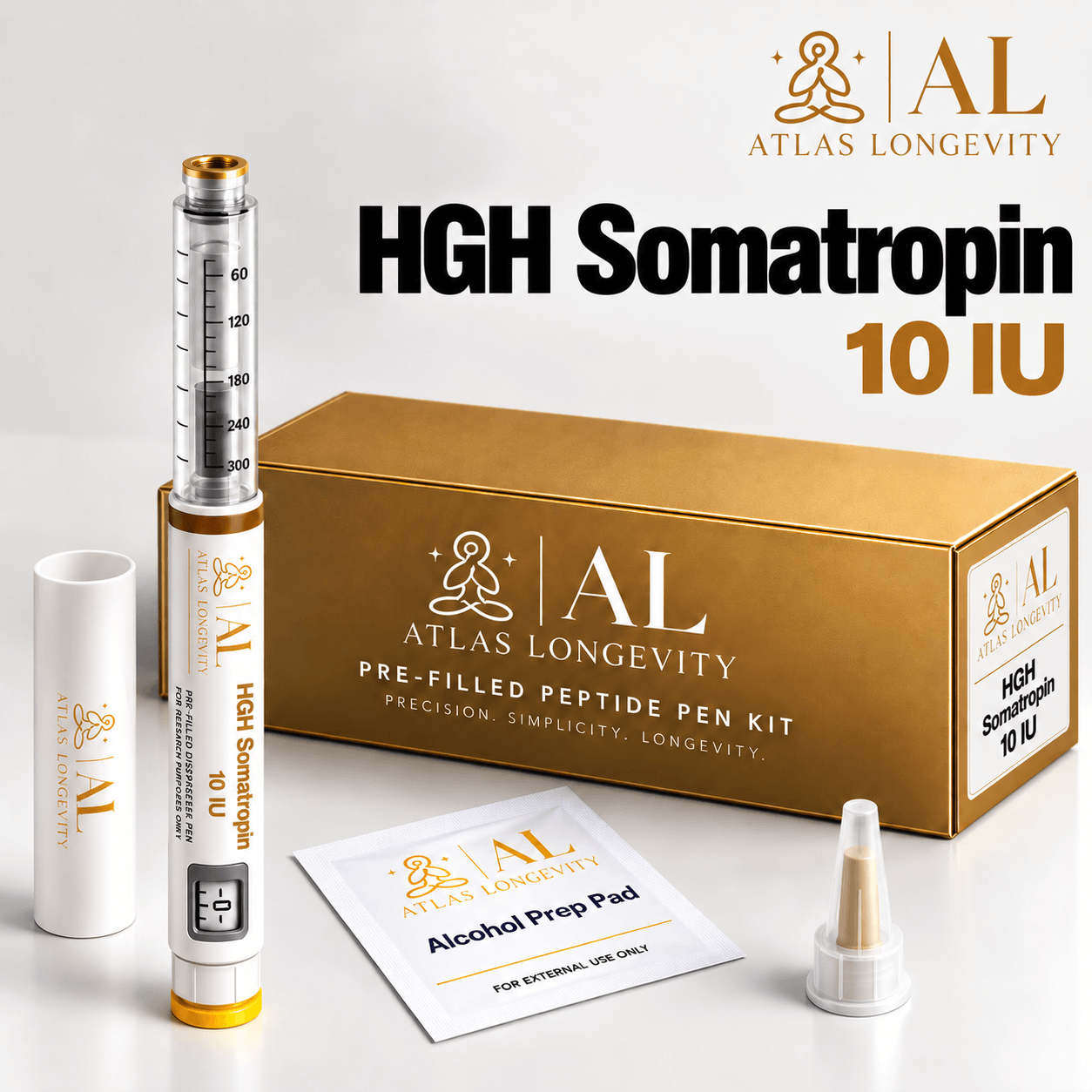
Atlas Longevity Somatropin pens are available in:
- 10 IU HGH Pen
- 36 IU HGH Pen
Both use the Atlas standard:
3 mL cartridge volume
300 total pen units / clicks
1 click = 0.01 mL
The 10 IU variant replaces the previously referenced 24 IU pen. The 36 IU variant remains available.
Clinical / Research Status
Somatropin has a substantially stronger clinical evidence base than most experimental peptides.
| Evidence Type | Status |
|---|---|
| Human randomized clinical research | Yes |
| Human observational research | Yes |
| Animal research | Yes |
| In-vitro research | Yes |
| Regulatory therapeutic use | Yes, for specific approved indications |
The supplied material describes Somatropin as an FDA-approved growth hormone medication for specific clinical conditions while emphasizing that uses outside approved indications remain investigational.
Approval of specific prescription Somatropin products should not automatically be interpreted as approval of the Atlas Longevity Somatropin pen or of anti-ageing, bodybuilding, performance-enhancement, or cosmetic uses.
Mechanism of Action
Somatropin binds to growth hormone receptors (GHRs) located throughout multiple tissues.
Growth hormone receptor activation initiates intracellular signalling involving:
- JAK2
- STAT5
- MAPK / ERK
- PI3K / Akt
- downstream mTOR-related signalling
These pathways influence gene transcription involved in:
- cellular growth;
- protein metabolism;
- tissue differentiation;
- repair processes;
- lipid metabolism.
IGF-1 Signalling
A major downstream effect of growth hormone is stimulation of IGF-1 production, particularly in the liver.
IGF-1 contributes to many of the anabolic and growth-related effects associated with the GH axis, including signalling within:
- skeletal muscle;
- bone;
- connective tissue;
- cartilage;
- other growth-responsive tissues.
Lipid Metabolism
Growth hormone also influences adipose-tissue metabolism and lipolytic pathways.
These metabolic actions are separate from its growth-promoting effects and are an important area of GH research.
Potential Benefits / Research Areas
Growth Hormone and IGF-1 Research
Somatropin is one of the principal compounds used to study direct growth hormone receptor activation.
Unlike GHRH analogues or secretagogues, Somatropin provides the growth hormone molecule itself rather than stimulating the pituitary to increase endogenous release.
This makes it useful for research comparing:
- direct GH exposure;
- GHRH stimulation;
- ghrelin-receptor secretagogues;
- downstream IGF-1 responses.
Protein Synthesis and Lean-Tissue Research
Growth hormone and IGF-1 are involved in protein metabolism.
Research has examined effects involving:
- amino-acid utilisation;
- nitrogen retention;
- protein turnover;
- lean body mass;
- skeletal-muscle signalling.
Changes in lean mass do not necessarily translate directly into proportional increases in functional strength or athletic performance.
Adipose-Tissue and Lipolysis Research
Somatropin has also been studied for its ability to influence:
- fat mobilisation;
- adipocyte metabolism;
- visceral adipose tissue;
- lipid oxidation.
This makes GH important in metabolic and body-composition research.
It should not be presented as an approved general fat-loss treatment.
Bone and Skeletal Research
Growth hormone and IGF-1 influence:
- osteoblast activity;
- bone turnover;
- skeletal growth;
- collagen synthesis;
- mineralisation.
Somatropin is therefore widely studied in growth and skeletal biology.
Connective-Tissue and Collagen Research
Experimental studies investigate GH/IGF-1 signalling in relation to:
- fibroblast activity;
- collagen production;
- extracellular matrix turnover;
- tissue remodelling.
These mechanisms provide a basis for regenerative research but do not establish guaranteed healing effects.
Metabolic Research
Growth hormone has complex effects on glucose and lipid metabolism.
Experimental endpoints include:
- insulin sensitivity;
- glucose utilisation;
- hepatic metabolism;
- lipid profiles;
- substrate distribution.
Importantly, increased GH exposure can also reduce insulin sensitivity, so its metabolic effects should not be characterized as universally beneficial.
Neurological and Neuroendocrine Research
GH and IGF-1 signalling also interact with the nervous system.
Research areas include:
- neuroendocrine regulation;
- cognition;
- sleep;
- brain GH signalling;
- neuronal IGF-1 pathways.
Evidence for direct cognitive enhancement remains less established than the endocrine and growth-related effects of Somatropin.
Skin and Extracellular-Matrix Research
Somatropin-related studies have also examined:
- dermal collagen;
- skin thickness;
- tissue hydration;
- extracellular-matrix biology.
These findings should remain framed as research rather than proven cosmetic anti-ageing outcomes.
Research Data
| Study / Model | Reported Finding |
|---|---|
| GH-deficient adult clinical studies | Increased lean body mass and reduced fat mass reported during GH replacement |
| Older-adult research | Changes in skin thickness and collagen-related measurements |
| Fracture animal models | Increased callus formation and osteoblast-related activity |
| Wound-healing research | Increased fibroblast activity and collagen synthesis in experimental systems |
| Human metabolic studies | Changes in lipid metabolism and glucose-related endpoints |
| Exercise and recovery studies | Changes in body composition and recovery-related markers |
| In-vitro cell research | Increased STAT5 signalling and IGF-1 gene expression |
| Long-term experimental models | Sustained effects on protein turnover and metabolic signalling |
Clinical outcomes depend strongly on the population studied, underlying GH status, exposure, duration, and formulation.
Somatropin vs GH Secretagogues
Somatropin should be distinguished from compounds such as:
- CJC-1295;
- Tesamorelin;
- Ipamorelin;
- GHRP-6.
Somatropin
Provides growth hormone directly.
GHRH Analogues
Compounds such as CJC-1295 and Tesamorelin stimulate the pituitary through the GHRH receptor.
Ghrelin-Receptor Secretagogues
Compounds such as Ipamorelin stimulate GH release through the GHS-R1a / ghrelin receptor pathway.
These approaches affect the GH axis differently and should not be treated as interchangeable.
Potential Stack / Combination Research
The supplied material discusses experimental combinations involving Somatropin with:
- IGF-1 LR3;
- BPC-157;
- TB-500;
- Epitalon;
- SS-31;
- NAD+;
- CJC-1295;
- Ipamorelin.
These combinations involve overlapping pathways related to growth signalling, regeneration, metabolism, or mitochondrial research.
Combining direct HGH with GH-releasing compounds can also increase overall GH/IGF-1 pathway exposure.
The supplied information does not establish validated safety, efficacy, compatibility, or dosing for these combinations.
They should therefore be treated as experimental research concepts rather than recommended stacks.
Atlas Longevity Somatropin Pen Dosage / Click Chart
Atlas Longevity Somatropin is available in:
10 IU
and:
36 IU
Both pens contain:
3 mL cartridge volume
300 total clicks
1 click = 0.01 mL
Maximum selectable dial amount = 60 clicks
HGH Somatropin 10 IU Pen
Pen Specification
| Pen Strength | Volume | Concentration | Amount Per Click |
|---|---|---|---|
| 10 IU | 3 mL | ≈3.333 IU/mL | ≈0.0333 IU |
Concentration Calculation
10 IU ÷ 3 mL = 3.3333 IU/mL
Rounded:
≈3.333 IU/mL
Amount Per Click
10 IU ÷ 300 clicks = 0.033333 IU per click
Therefore:
1 click ≈0.0333 IU
10 IU Pen Click Conversion Chart
| Clicks | Volume | Somatropin Amount |
|---|---|---|
| 1 | 0.01 mL | ≈0.033 IU |
| 5 | 0.05 mL | ≈0.167 IU |
| 10 | 0.10 mL | ≈0.333 IU |
| 15 | 0.15 mL | 0.500 IU |
| 20 | 0.20 mL | ≈0.667 IU |
| 30 | 0.30 mL | 1.000 IU |
| 40 | 0.40 mL | ≈1.333 IU |
| 45 | 0.45 mL | 1.500 IU |
| 50 | 0.50 mL | ≈1.667 IU |
| 60 | 0.60 mL | 2.000 IU |
Useful 10 IU Conversions
- 15 clicks = 0.5 IU
- 30 clicks = 1 IU
- 45 clicks = 1.5 IU
- 60 clicks = 2 IU
The maximum amount selectable in one dial operation is:
60 clicks = 2 IU
HGH Somatropin 36 IU Pen
Pen Specification
| Pen Strength | Volume | Concentration | Amount Per Click |
|---|---|---|---|
| 36 IU | 3 mL | 12 IU/mL | 0.12 IU |
Concentration Calculation
36 IU ÷ 3 mL = 12 IU/mL
Amount Per Click
36 IU ÷ 300 clicks = 0.12 IU per click
Therefore:
1 click = 0.12 IU
36 IU Pen Click Conversion Chart
| Clicks | Volume | Somatropin Amount |
|---|---|---|
| 1 | 0.01 mL | 0.12 IU |
| 5 | 0.05 mL | 0.60 IU |
| 8 | 0.08 mL | 0.96 IU |
| 10 | 0.10 mL | 1.20 IU |
| 15 | 0.15 mL | 1.80 IU |
| 20 | 0.20 mL | 2.40 IU |
| 25 | 0.25 mL | 3.00 IU |
| 30 | 0.30 mL | 3.60 IU |
| 40 | 0.40 mL | 4.80 IU |
| 50 | 0.50 mL | 6.00 IU |
| 60 | 0.60 mL | 7.20 IU |
Useful 36 IU Conversions
- 5 clicks = 0.60 IU
- 8 clicks = 0.96 IU
- 10 clicks = 1.20 IU
- 15 clicks = 1.80 IU
- 20 clicks = 2.40 IU
- 25 clicks = 3 IU
- 50 clicks = 6 IU
- 60 clicks = 7.20 IU
The maximum amount selectable in one dial operation is:
60 clicks = 7.20 IU
These figures describe concentration mathematics and pen mechanics rather than recommended dosing.
Protocol / Dosage Information
The supplied source describes experimental quantities ranging approximately from:
1 IU to 5 IU
Its original 24 IU variant has now been replaced by the Atlas 10 IU pen, so all original click calculations for that variant are no longer applicable.
Using the new Atlas system:
| Source-Referenced Amount | 10 IU Pen | 36 IU Pen |
|---|---|---|
| 1 IU | 30 clicks | ≈8.33 clicks* |
| 1.5 IU | 45 clicks | 12.5 clicks* |
| 2 IU | 60 clicks | ≈16.67 clicks* |
| 2.5 IU | 75 total clicks | ≈20.83 clicks* |
| 3 IU | 90 total clicks | 25 clicks |
| 4 IU | 120 total clicks | ≈33.33 clicks* |
| 5 IU | 150 total clicks | ≈41.67 clicks* |
*These values do not correspond exactly to whole-click settings.
Important 10 IU Pen Limitation
The 10 IU pen allows a maximum single dial selection of:
60 clicks = 2 IU
Therefore:
- 2.5 IU = 75 clicks mathematically;
- 3 IU = 90 clicks mathematically;
- 4 IU = 120 clicks mathematically;
- 5 IU = 150 clicks mathematically.
Those quantities cannot be selected as one dial amount.
They are shown only as mathematical conversions of source-referenced research quantities and are not instructions to divide or repeat administrations.
The source’s daily, alternate-day, nighttime, cycle-duration, and high-intensity schedules should not be reproduced as self-administration guidance.
Possible Side Effects
Somatropin has a well-characterized physiological effect profile because it directly activates the growth hormone pathway.
The supplied material identifies potential effects including:
- peripheral edema;
- fluid retention;
- joint discomfort;
- arthralgia;
- carpal-tunnel-type symptoms;
- headache;
- changes in glucose tolerance;
- insulin resistance;
- hyperglycaemia;
- fatigue.
Fluid Retention
Growth hormone can influence sodium and fluid balance.
This may contribute to:
- swelling;
- edema;
- soft-tissue fullness;
- nerve-compression symptoms.
Glucose and Insulin Sensitivity
One of the most important metabolic considerations is that GH can reduce insulin sensitivity.
Prolonged or excessive exposure may therefore influence:
- fasting glucose;
- glucose tolerance;
- insulin resistance.
Carpal-Tunnel-Type Symptoms
Soft-tissue and fluid changes associated with GH exposure may contribute to:
- tingling;
- numbness;
- nerve-compression symptoms.
Long-Term Growth Signalling
Prolonged excessive growth hormone exposure may produce unwanted tissue-growth effects.
The source mentions concern regarding acromegaly-like changes and cardiovascular strain with prolonged excessive exposure.
Because growth hormone also increases IGF-1 signalling, long-term systemic exposure should not be described as risk-free.
Product Attributes
| Attribute | Information |
|---|---|
| Compound Name | Somatropin |
| Common Name | Human Growth Hormone / HGH |
| CAS Number | 12629-01-5 |
| Molecular Formula | C990H1529N263O299S7 |
| Amino Acid Length | 191 amino acids |
| Molecular Weight | Approximately 22,125 g/mol |
| Half-Life listed by source | Approximately 2–4 hours |
| Synonyms | Somatotropin, rhGH, Human Growth Hormone |
| Compound Type | Recombinant human growth hormone |
| Primary Receptor | Growth Hormone Receptor |
| Research Focus | Growth signalling, IGF-1, metabolism, body composition, tissue and skeletal biology |
The competitor source lists several branded pharmaceutical products as synonyms. Those proprietary product names should not be used as Atlas Longevity product terminology.
Final identity, potency, IU standardization, formulation, and analytical specifications should match the actual Atlas Longevity Certificate of Analysis.
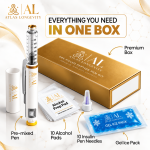
Included in the Box
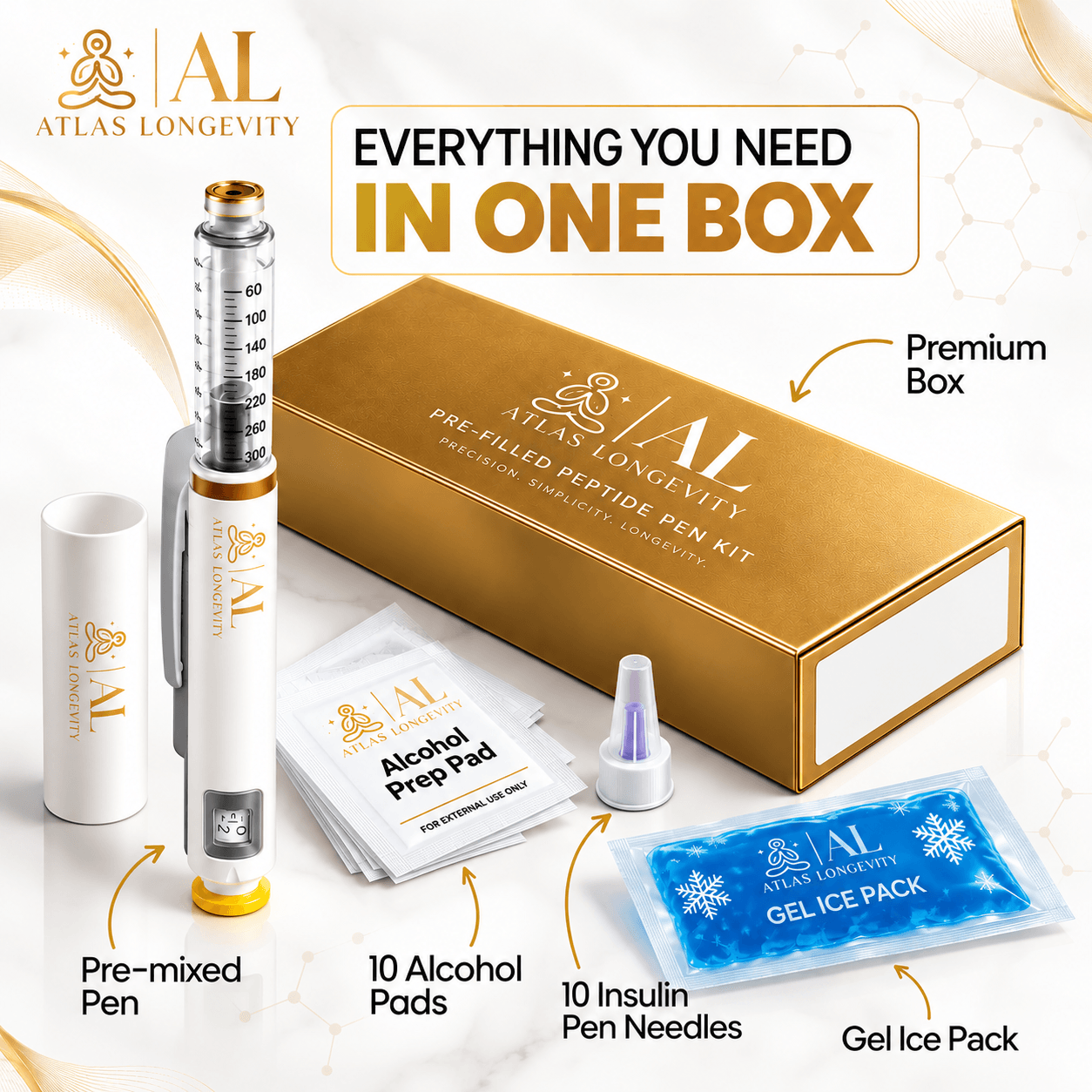
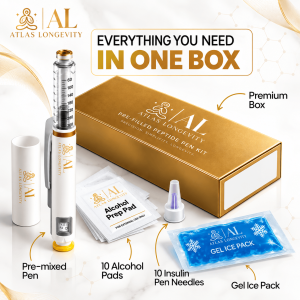
Each Atlas Longevity product is carefully packed to support secure storage, clean handling, and convenient research use. Inside the package, you’ll find the essential items needed for organized laboratory handling:
- 1× Ready-to-Use Injection Pen
- 10× Ultra-Fine Needles (33G, 4 mm)
- 10× Alcohol Prep Pads
- Protective Foam Insert to help keep the pen secure during transport
- Quick-Reference Instruction Panel inside the packaging
- Tamper-Evident Security Seal for added package protection
Each component is arranged in a clean, protective presentation designed to keep the product secure and easy to access.
Storage
Storage conditions should follow the instructions supplied specifically with the Atlas Longevity Somatropin formulation.
The reference product provides refrigeration and stability specifications for its own finished formulation. Those conditions should not automatically be transferred to Atlas Longevity without product-specific stability evidence.
Follow the temperature requirements, light-protection guidance, shelf-life information, and handling instructions shown on the Atlas Longevity product label or accompanying documentation.
Frequently Asked Questions
What is Somatropin?
Somatropin is recombinant human growth hormone (rhGH) composed of 191 amino acids.
It is designed to reproduce the biological activity of endogenous pituitary growth hormone.
Is Somatropin the same as HGH?
Somatropin is recombinant human growth hormone and is commonly referred to as HGH or rhGH.
Is Somatropin the same as CJC-1295?
No.
Somatropin provides growth hormone directly.
CJC-1295 is a GHRH analogue that stimulates the pituitary to release endogenous growth hormone.
Is Somatropin the same as IGF-1?
No.
Growth hormone stimulates IGF-1 production, but the two are different hormones with different receptors and physiological functions.
How does Somatropin work?
Somatropin activates the growth hormone receptor, triggering JAK2/STAT5 and related intracellular signalling.
It also increases downstream production of IGF-1.
What is Somatropin researched for?
Research areas include:
- GH receptor signalling;
- IGF-1;
- growth biology;
- protein metabolism;
- lean body mass;
- fat metabolism;
- bone;
- connective tissue;
- glucose metabolism;
- neuroendocrine physiology.
Has Somatropin been studied in humans?
Yes.
Somatropin has extensive human clinical and regulatory history for defined medical indications.
That evidence should not be generalized to unapproved performance or anti-ageing applications.
Is Somatropin approved?
Specific Somatropin medicines are approved for certain diagnosed growth-hormone-related conditions.
That does not automatically establish approval of the Atlas Longevity product or other uses.
What strengths are available from Atlas Longevity?
Atlas Longevity Somatropin is available in:
10 IU
and:
36 IU
The previous 24 IU option has been replaced by 10 IU.
How much Somatropin is in one click of the 10 IU pen?
The 10 IU pen contains:
10 IU ÷ 300 = approximately 0.0333 IU per click
How much Somatropin is in one click of the 36 IU pen?
The 36 IU pen contains:
36 IU ÷ 300 = 0.12 IU per click
How many clicks equal 1 IU on the 10 IU pen?
30 clicks = 1 IU
How many clicks equal 2 IU on the 10 IU pen?
60 clicks = 2 IU
How many clicks equal 1 IU on the 36 IU pen?
Mathematically:
1 IU ÷ 0.12 IU ≈8.33 clicks
Because the pen uses whole clicks, exactly 1 IU cannot be selected using a whole-click setting.
For reference:
8 clicks = 0.96 IU
9 clicks = 1.08 IU
How many clicks equal 3 IU on the 36 IU pen?
25 clicks = 3 IU
How many clicks equal 5 IU on the 36 IU pen?
Mathematically:
≈41.67 clicks
This does not correspond exactly to a whole-click setting.
What is the maximum selectable amount on the 10 IU pen?
The maximum single dial selection is:
60 clicks
which equals:
2 IU
What is the maximum selectable amount on the 36 IU pen?
The maximum single dial selection is:
60 clicks
which equals:
7.20 IU
These are pen-mechanics calculations and not recommended quantities.
How long does the 10 IU Somatropin pen last?
The pen contains:
300 clicks and 10 IU total Somatropin.
For cartridge-capacity calculations only:
- 15 clicks at a time = 20 administrations
- 30 clicks at a time = 10 administrations
- 60 clicks at a time = 5 administrations
How long does the 36 IU Somatropin pen last?
The 36 IU variant also contains:
300 total clicks
but each click contains more Somatropin:
0.12 IU per click
For cartridge-capacity calculations only:
- 10 clicks at a time = 30 administrations
- 20 clicks at a time = 15 administrations
- 30 clicks at a time = 10 administrations
- 60 clicks at a time = 5 administrations
Does the product disappear when the dial returns to zero?
No.
The dial returns to zero after administration while unused formulation remains in the cartridge.
The remaining Somatropin stays inside the pen until all 300 units have been used.
Can Somatropin increase IGF-1?
Yes.
Increasing IGF-1 is one of the major downstream biological effects of growth hormone receptor activation.
Can Somatropin affect blood glucose?
Yes.
Growth hormone can reduce insulin sensitivity and alter glucose tolerance, particularly with prolonged or excessive exposure.
Can Somatropin cause water retention?
Yes.
Fluid retention and peripheral edema are well-recognized effects associated with growth hormone signalling.
Can Somatropin cause carpal tunnel symptoms?
The supplied material reports tingling and nerve-compression-type symptoms associated with soft-tissue and fluid changes.
Can Somatropin be combined with CJC-1295 or Ipamorelin?
The source discusses such combinations experimentally.
However, Somatropin supplies GH directly while CJC-1295 and Ipamorelin stimulate endogenous GH pathways.
Using them together may increase overlapping GH/IGF-1 exposure, and validated combination safety and dosing are not established by the supplied material.
Is there an established dosage for the Atlas Somatropin pen?
Prescription Somatropin products have indication-specific medical dosing determined according to individual clinical circumstances.
The Atlas click charts above provide concentration mathematics only and should not be interpreted as treatment instructions.
How should the Atlas Longevity Somatropin pen be stored?
Follow the storage instructions supplied specifically with the actual Atlas Longevity Somatropin formulation.
The competitor manufacturer’s refrigeration and stability specifications apply to its own finished product and should not automatically be transferred to Atlas without formulation-specific stability evidence.
Related products
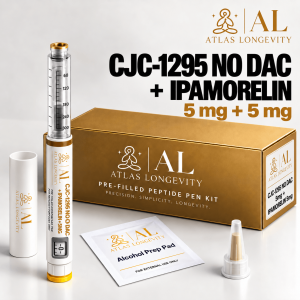
CJC-1295 No DAC 5mg + Ipamorelin 5mg Pen
Price range: Rp1,900,000.00 through Rp2,500,000.00 ~$115.15–$151.52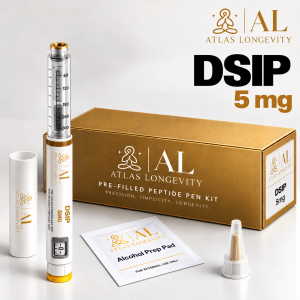
DSIP Pen
Price range: Rp1,300,000.00 through Rp2,600,000.00 ~$78.79–$157.58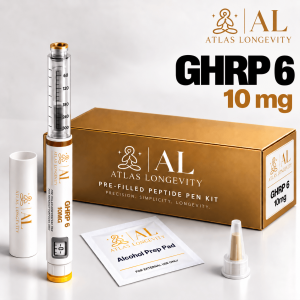
GHRP 6 10MG
Price range: Rp1,900,000.00 through Rp2,500,000.00 ~$115.15–$151.52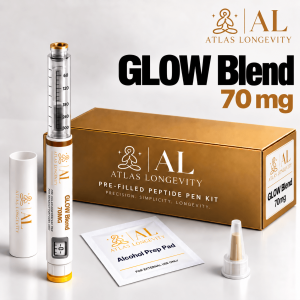
Glow Plus 70mg Pen (GHK-Cu + BPC-157 + TB-500)
Price range: Rp3,000,000.00 through Rp3,600,000.00 ~$181.82–$218.18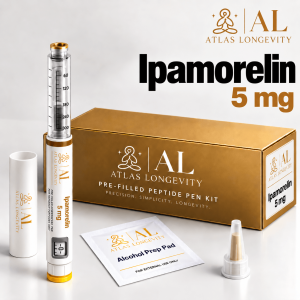
Ipamorelin Pen
Price range: Rp1,200,000.00 through Rp2,600,000.00 ~$72.73–$157.58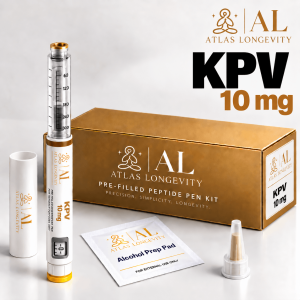
KPV 10mg Pen
Price range: Rp1,500,000.00 through Rp2,100,000.00 ~$90.91–$127.27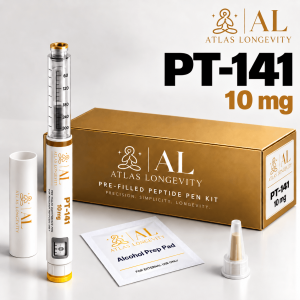
PT-141 Pen
Price range: Rp1,600,000.00 through Rp2,200,000.00 ~$96.97–$133.33
 Peptide Vials
 Peptide Nasal Sprays
 Peptide Protocols
 Bundles