
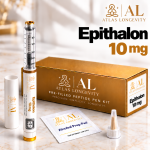

Epithalon Peptide Pen
Price range: Rp1,800,000.00 through Rp4,050,000.00 ~$109.09–$245.45
Epithalon 20 mg Pen
Product Description
Epithalon, also known as Epitalon, is a synthetic tetrapeptide composed of four amino acids: alanine, glutamic acid, aspartic acid, and glycine (AEDG).
It originates from research involving epithalamin, a pineal-derived preparation investigated in ageing biology. Epithalon subsequently became a subject of experimental research focused on telomerase activity, telomere biology, cellular senescence, circadian signalling, oxidative stress, and longevity-related cellular pathways. Pasted text
One of its best-known research areas involves whether Epithalon can influence telomerase, an enzyme involved in maintaining telomeric DNA at chromosome ends during cellular replication.
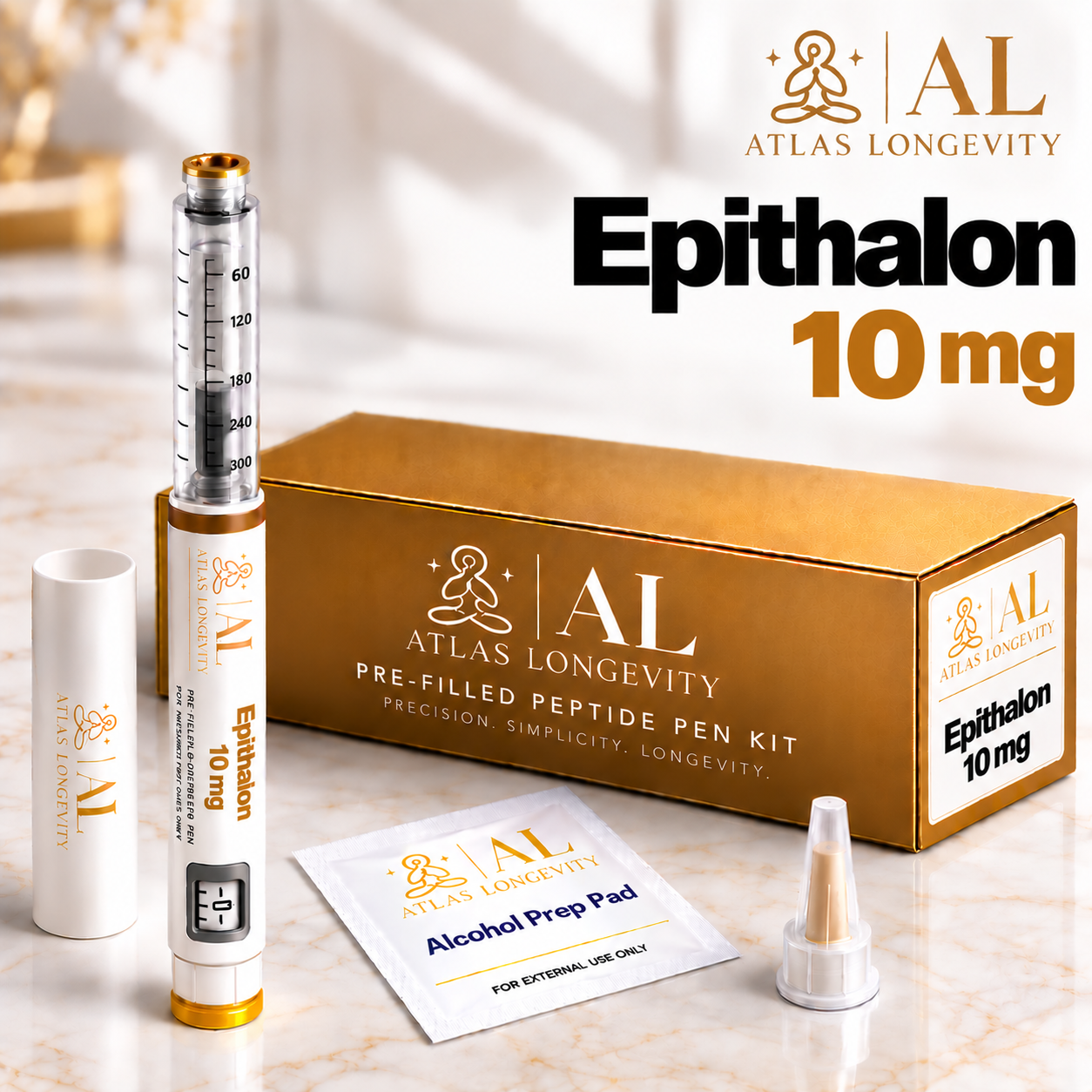
The Atlas Longevity Epithalon pen contains 20 mg in a 3 mL pre-mixed cartridge with 300 total units/clicks.
Epithalon remains an investigational research peptide and should not be presented as an approved anti-ageing, longevity, sleep, or medical treatment.
Clinical / Research Status
Epithalon has primarily been investigated in preclinical, laboratory, and regional ageing research, with limited exploratory human evidence.
The supplied material describes the available evidence as follows: Pasted text
| Evidence Type | Status Based on Supplied Material |
|---|---|
| Human controlled research | Limited |
| Human observational research | Limited |
| Animal research | Yes |
| In-vitro research | Yes |
| Regulatory therapeutic approval | Not established |
Human observations should not be treated as equivalent to large, independently replicated randomized clinical trials.
Similarly, laboratory evidence involving telomerase or cellular lifespan cannot be translated directly into claims of increased human lifespan.
Evidence Type
The supplied research material includes:
- human somatic-cell studies;
- telomerase and telomere-length experiments;
- animal longevity models;
- pineal and circadian research;
- observational human ageing studies;
- oxidative-stress experiments;
- retinal injury models;
- immunosenescence research. Pasted text
Evidence strength varies significantly between these areas.
Mechanism of Action
Epithalon is primarily researched for its potential influence on telomerase activity and telomere biology.
Telomeres are repetitive DNA structures located at chromosome ends. They protect chromosomes during cellular replication but generally become progressively shorter as cells divide.
Telomerase is an enzyme capable of extending telomeric DNA.
Laboratory studies referenced in the supplied material have investigated whether Epithalon can increase telomerase activity and influence telomere maintenance in dividing human cells. Pasted text
Beyond telomere biology, Epithalon has also been explored in research involving:
- cellular senescence;
- chromosomal stability;
- pineal signalling;
- melatonin rhythms;
- oxidative-stress responses;
- circadian regulation.
The precise biological effects and their relevance to human ageing remain under investigation.
Potential Benefits / Research Areas
Telomerase Activation Research
Epithalon is particularly associated with experimental research into telomerase activation.
In laboratory cell models, researchers have investigated whether Epithalon can influence telomerase activity and consequently affect telomere length in dividing cells. Pasted text
These results are scientifically interesting, but increased telomerase activity in cultured cells does not demonstrate that Epithalon extends human lifespan.
Telomere Maintenance
Telomeres progressively shorten during repeated cell division.
Because critically shortened telomeres can contribute to replicative senescence, researchers have investigated whether maintaining telomeric DNA could influence cellular ageing processes.
Epithalon’s proposed influence on this pathway places it within telomere-maintenance and cellular-ageing research.
Genomic Stability Research
Telomere dysfunction can contribute to chromosomal instability and altered cellular behaviour.
Epithalon is therefore studied in experimental models examining relationships between telomere integrity, chromosome protection, and genomic stability. Pasted text
This remains a mechanistic research area rather than an established clinical benefit.
Cellular Senescence
Cellular senescence occurs when cells enter a persistent state of growth arrest and undergo changes in gene expression and signalling.
Because telomere shortening can contribute to senescence, researchers have explored whether telomerase-related mechanisms influenced by Epithalon may affect the timing or characteristics of cellular ageing. Pasted text
Pineal and Circadian Research
Epithalon originated from research involving epithalamin and pineal-gland biology.
The pineal gland participates in circadian regulation and melatonin secretion, creating a second major area of Epithalon research beyond telomere biology.
Experimental work has investigated potential effects on:
- melatonin rhythms;
- sleep-related endocrine timing;
- pineal activity;
- circadian synchronization. Pasted text
Evidence does not establish Epithalon as an approved treatment for insomnia or circadian-rhythm disorders.
Oxidative-Stress Research
Oxidative stress can contribute to cellular injury and may accelerate telomere attrition.
Laboratory research involving Epithalon has therefore examined markers of oxidative stress alongside telomere and ageing-related pathways. Pasted text
The supplied material reports changes in lipid-peroxidation markers and antioxidant-related activity in experimental models.
Replicative Lifespan Research
Cellular experiments have investigated whether alterations in telomerase activity can influence the number of times certain cells can divide before entering replicative senescence.
This has led to Epithalon being discussed in cellular lifespan and longevity research. Pasted text
Cellular lifespan should not be confused with organism or human lifespan.
Integrated Ageing Biology
Ageing involves multiple interacting biological processes rather than one isolated pathway.
The supplied research positions Epithalon at the intersection of:
- telomere biology;
- cellular senescence;
- oxidative stress;
- circadian regulation;
- pineal signalling;
- age-associated cellular changes. Pasted text
For this reason, it remains of interest in experimental longevity research despite significant unanswered clinical questions.
Research Data
| Study / Model | Reported Finding |
|---|---|
| Human somatic-cell culture | Increased telomerase activity and changes in telomere length |
| Aged mouse longevity models | Changes in median lifespan and age-associated tumour incidence were reported |
| Pineal-gland animal models | Changes in melatonin secretion rhythm and circadian markers |
| Elderly observational cohort | Changes in sleep measures and nocturnal melatonin were reported |
| Rat retinal-degeneration model | Reduced photoreceptor loss and changes in retinal integrity |
| In-vitro oxidative-stress studies | Reduced lipid-peroxidation markers and altered antioxidant-enzyme expression |
| Rodent immunosenescence research | Changes in T-cell function and thymic activity |
These studies include in-vitro, animal, and observational human evidence and should not be treated as equivalent levels of clinical proof. Pasted text
In particular, longevity findings in rodents should not be converted into predictions of increased lifespan in humans.
Potential Stack / Combination Research
The supplied reference discusses experimental combination concepts involving Epithalon with:
- BPC-157;
- GHK-Cu;
- NAD+;
- Thymalin. Pasted text
These combinations are discussed around research themes including telomere biology, tissue regeneration, extracellular-matrix biology, mitochondrial metabolism, pineal signalling, and immunosenescence.
However, the supplied information does not establish validated human safety, efficacy, compatibility, or dosing for these combinations.
They should therefore be considered experimental research concepts rather than recommended protocols.
Atlas Longevity Epithalon Pen Dosage / Click Chart
The Atlas Longevity Epithalon pen contains:
20 mg Epithalon
3 mL cartridge volume
300 total clicks
1 click = 0.01 mL
Maximum selectable dial amount = 60 clicks
Pen Specification
| Pen Strength | Volume | Concentration | Amount Per Click |
|---|---|---|---|
| 20 mg | 3 mL | ≈6.667 mg/mL | ≈0.0667 mg / 66.7 mcg |
Concentration Calculation
20 mg ÷ 3 mL = 6.6667 mg/mL
Rounded:
≈6.667 mg/mL
Amount Per Click
20 mg ÷ 300 clicks = 0.0666667 mg per click
Therefore:
1 click ≈0.0667 mg
or:
≈66.7 mcg
Epithalon Click Conversion Chart
| Clicks | Volume | Epithalon Amount |
|---|---|---|
| 1 | 0.01 mL | ≈0.0667 mg / 66.7 mcg |
| 5 | 0.05 mL | ≈0.333 mg / 333 mcg |
| 10 | 0.10 mL | ≈0.667 mg / 667 mcg |
| 15 | 0.15 mL | 1.000 mg |
| 20 | 0.20 mL | ≈1.333 mg |
| 30 | 0.30 mL | 2.000 mg |
| 40 | 0.40 mL | ≈2.667 mg |
| 45 | 0.45 mL | 3.000 mg |
| 50 | 0.50 mL | ≈3.333 mg |
| 60 | 0.60 mL | 4.000 mg |
Useful Conversions
- 15 clicks = 1 mg
- 30 clicks = 2 mg
- 45 clicks = 3 mg
- 60 clicks = 4 mg
The maximum amount that can be selected in one dial operation is:
60 clicks = 0.60 mL = 4 mg Epithalon
This is a concentration and pen-mechanics calculation, not a dosing recommendation.
Protocol / Dosage Information
The supplied source describes experimental research quantities ranging from approximately 2 mg to 20 mg across several proposed protocols. Pasted text
The original click calculations were based on a different 2 mL pen formulation and therefore must not be used for the Atlas Longevity pen.
Using the Atlas 20 mg / 3 mL / 300-click formulation:
| Source-Referenced Amount | Mathematical Atlas Equivalent |
|---|---|
| 2 mg | 30 total clicks |
| 3 mg | 45 total clicks |
| 4 mg | 60 total clicks |
| 5 mg | 75 total clicks |
| 10 mg | 150 total clicks |
| 20 mg | 300 total clicks |
Because the Atlas pen has a maximum selectable dial range of 60 clicks, quantities above 4 mg cannot be selected as a single dial amount.
The figures above therefore represent only mathematical conversion of the source-referenced quantities. They are not instructions to divide, repeat, or administer multiple selections.
The supplied evidence does not establish a universally accepted clinical dose, treatment duration, cycling schedule, or approved human protocol for Epithalon.
Possible Side Effects
Human safety evidence for Epithalon remains limited.
The supplied material describes reported effects including:
- temporary drowsiness;
- mild fatigue;
- localized redness or tenderness;
- headache;
- temporary changes in sleep patterns. Pasted text
The source also reports an absence of certain hormonal, hepatic, or systemic adverse effects within available research.
However, limited detection of adverse effects should not be interpreted as proof of safety.
The supplied material does not establish a comprehensive understanding of:
- long-term human safety;
- contraindications;
- medication interactions;
- reproductive effects;
- cancer-related risks;
- consequences of prolonged telomerase modulation;
- risks associated with combination research.
The last point is especially important because telomerase biology is complex; increasing telomerase activity should not automatically be characterized as universally beneficial.
Product Attributes
| Attribute | Information |
|---|---|
| Compound Name | Epithalon |
| Alternative Name | Epitalon |
| CAS Number | 307297-39-8 |
| Molecular Formula | C14H22N4O9 |
| Amino Acid Sequence | AEDG |
| Molecular Weight | 390.35 g/mol |
| PubChem CID | 219042 |
| Half-Life listed by source | Approximately 30 minutes |
| Synonyms | Epitalon, Epithalone, Ala-Glu-Asp-Gly, AEDG peptide |
| Compound Type | Synthetic research tetrapeptide |
| Research Focus | Telomere biology, cellular ageing, circadian and longevity research |
These specifications are reported in the supplied reference material.
Included in the Box
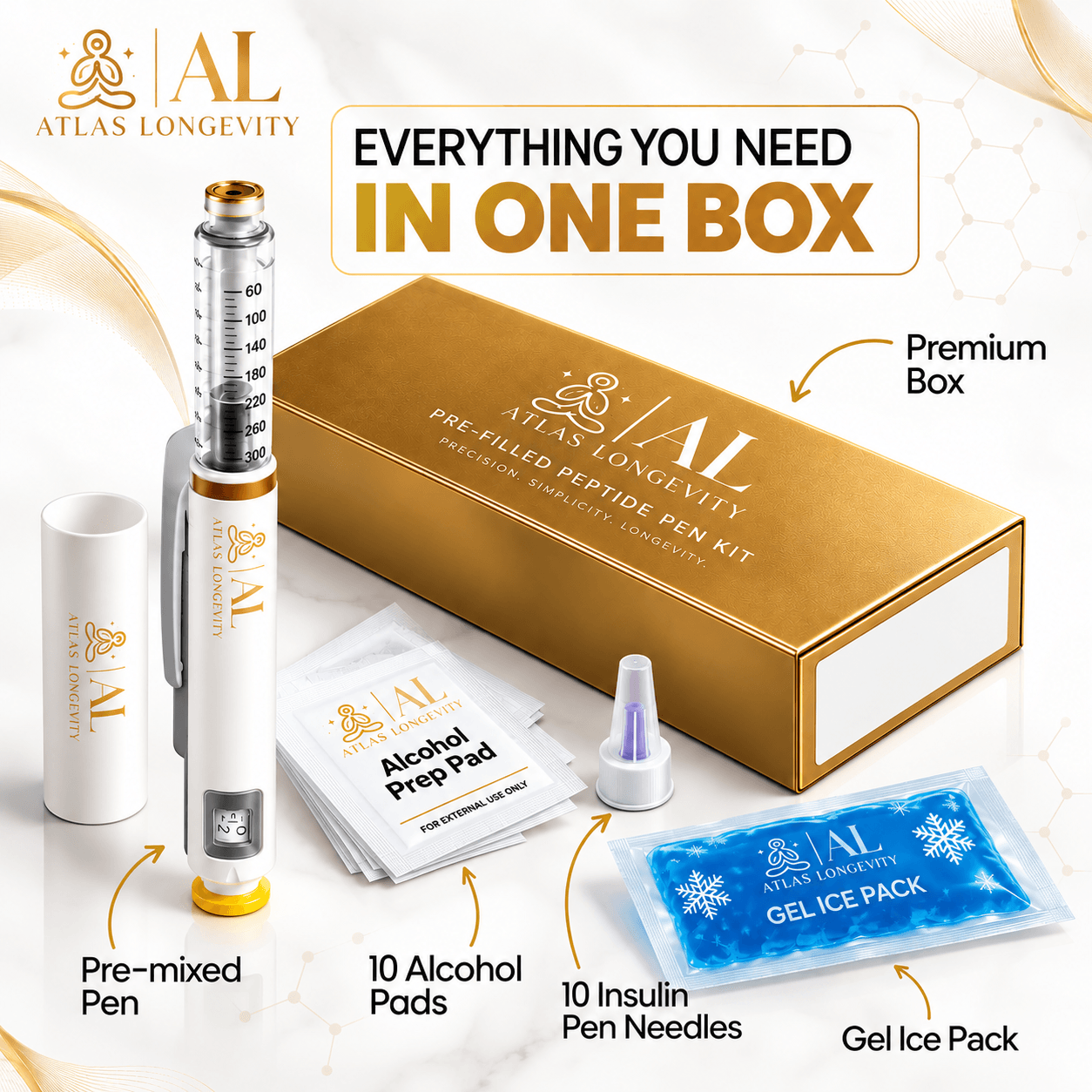
Each Atlas Longevity product is carefully packed to support secure storage, clean handling, and convenient research use. Inside the package, you’ll find the essential items needed for organized laboratory handling:
- 1× Ready-to-Use Injection Pen
- 10× Ultra-Fine Needles (33G, 4 mm)
- 10× Alcohol Prep Pads
- Protective Foam Insert to help keep the pen secure during transport
- Quick-Reference Instruction Panel inside the packaging
- Tamper-Evident Security Seal for added package protection
Each component is arranged in a clean, protective presentation designed to keep the product secure and easy to access.
Storage
Storage conditions should follow the instructions supplied specifically with the Atlas Longevity Epithalon formulation.
The reference source provides refrigeration and stability specifications for its own pre-mixed product. Those conditions should not automatically be transferred to an Atlas Longevity formulation without product-specific stability data.
Follow the temperature requirements, light-protection guidance, shelf-life information, and handling instructions shown on the Atlas Longevity product label or accompanying product documentation.
Frequently Asked Questions
What is Epithalon?
Epithalon is a synthetic four-amino-acid peptide with the sequence:
Ala-Glu-Asp-Gly (AEDG)
It has primarily been investigated in experimental research involving telomere biology, cellular ageing, pineal function, circadian regulation, and longevity-related pathways. Pasted text
Is Epithalon the same as Epitalon?
The supplied material lists Epitalon, Epithalone, and AEDG peptide as synonyms or alternative names associated with Epithalon. Pasted text
How does Epithalon work?
One major research mechanism involves potential modulation of telomerase, an enzyme involved in maintaining telomeres during cellular replication.
Laboratory research has examined whether Epithalon can increase telomerase activity and affect telomere length in dividing cells.
Its exact physiological significance in humans remains uncertain.
What are telomeres?
Telomeres are protective DNA structures located at the ends of chromosomes.
They generally become shorter as cells repeatedly divide, and critically shortened telomeres can contribute to cellular senescence.
Does Epithalon lengthen telomeres?
The supplied material describes in-vitro human somatic-cell research reporting increased telomerase activity and changes in telomere length. Pasted text
That does not establish that Epithalon reliably lengthens telomeres throughout the human body or produces clinical anti-ageing effects.
Does Epithalon increase lifespan?
Animal longevity experiments are included in the supplied research material.
However, animal lifespan findings cannot be converted into expected human lifespan extension.
There is not enough evidence in the supplied material to claim that Epithalon increases human lifespan.
What is Epithalon being researched for?
Research areas include:
- telomerase activity;
- telomere maintenance;
- cellular senescence;
- genomic stability;
- ageing biology;
- pineal signalling;
- circadian rhythms;
- melatonin regulation;
- oxidative stress;
- immunosenescence.
Evidence strength varies significantly between these areas.
Has Epithalon been studied in humans?
Limited human observational and exploratory research is described in the supplied material.
However, the source itself characterizes the human evidence base as limited. Pasted text
How much Epithalon is in each Atlas Longevity pen?
Each Atlas Longevity pen contains:
20 mg Epithalon in 3 mL.
What is the concentration of the Epithalon pen?
The concentration is:
20 mg ÷ 3 mL = approximately 6.667 mg/mL
How many clicks are in an Atlas Longevity Epithalon pen?
Each pen contains:
300 total clicks / units
with:
1 click = 0.01 mL
How much Epithalon is in one click?
Each click contains approximately:
0.0667 mg
or:
66.7 mcg Epithalon
How many clicks equal 1 mg Epithalon?
15 clicks = 1 mg.
How many clicks equal 2 mg?
30 clicks = 2 mg.
How many clicks equal 3 mg?
45 clicks = 3 mg.
How many clicks equal 4 mg?
60 clicks = 4 mg.
These are concentration calculations rather than dosing recommendations.
Can 5 mg be selected in one dial operation?
No.
Mathematically:
5 mg = 75 total clicks
but the Atlas pen allows a maximum of 60 clicks per single dial selection.
Therefore, 5 mg exceeds the pen’s single-selection range.
This does not provide instructions for administering a 5 mg amount; it simply explains the mechanical limitation of the pen.
What is the maximum selectable amount on the Epithalon pen?
The maximum selection is:
60 clicks
which equals:
0.60 mL
and:
4 mg Epithalon
This describes pen mechanics, not a recommended dose.
How long does an Epithalon pen last?
Each pen contains 300 total clicks and 20 mg total Epithalon.
The number of possible administrations depends on how many clicks are selected each time.
For cartridge-capacity calculation only:
- 15 clicks at a time = 20 administrations
- 30 clicks at a time = 10 administrations
- 60 clicks at a time = 5 administrations
These examples are mathematical capacity calculations rather than treatment protocols.
Does the medication disappear when the dial returns to zero?
No.
After administration, the dial returns to zero while the unused formulation remains inside the cartridge.
The remaining Epithalon stays in the pen until the cartridge’s 300 total units have been used.
Is Epithalon an approved anti-ageing treatment?
The supplied information does not establish regulatory approval of Epithalon as an anti-ageing or longevity therapy.
Laboratory or animal findings concerning telomeres and ageing should not be interpreted as therapeutic approval or guaranteed human outcomes.
Can Epithalon be combined with other compounds?
The supplied material discusses experimental research concepts involving Epithalon alongside BPC-157, GHK-Cu, NAD+, and Thymalin. Pasted text
However, it does not establish validated human safety, compatibility, efficacy, or dosing for these combinations.
How should the Atlas Longevity Epithalon pen be stored?
Follow the storage instructions supplied with the actual Atlas Longevity formulation.
The reference product describes specific refrigeration and stability conditions for its own formulation, but those specifications should not automatically be applied to Atlas without product-specific stability evidence.
Related products
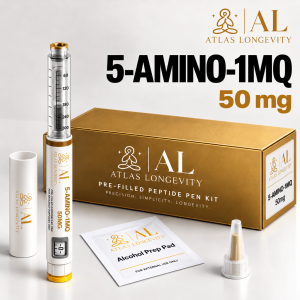

5-AMINO-1MQ
Price range: Rp3,700,000.00 through Rp6,800,000.00 ~$224.24–$412.12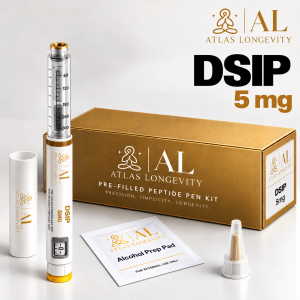
DSIP Pen
Price range: Rp1,300,000.00 through Rp2,600,000.00 ~$78.79–$157.58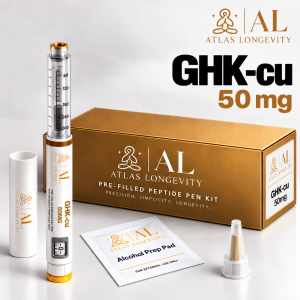
GHK-Cu Peptide Pen
Price range: Rp1,400,000.00 through Rp3,000,000.00 ~$84.85–$181.82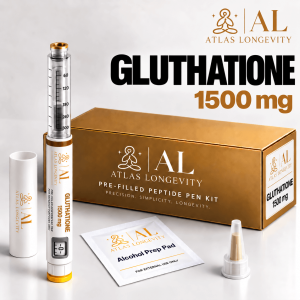
Glutathione 1500mg Pen
Price range: Rp2,500,000.00 through Rp3,100,000.00 ~$151.52–$187.88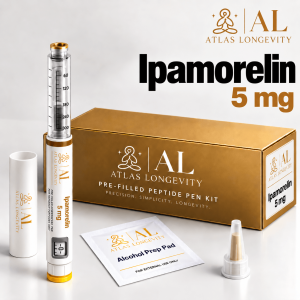
Ipamorelin Pen
Price range: Rp1,200,000.00 through Rp2,600,000.00 ~$72.73–$157.58
KPV 10mg Pen
Price range: Rp1,500,000.00 through Rp2,100,000.00 ~$90.91–$127.27
Selank 10mg Pen
Price range: Rp1,600,000.00 through Rp2,200,000.00 ~$96.97–$133.33
 Peptide Vials
 Peptide Nasal Sprays
 Peptide Protocols
 Bundles